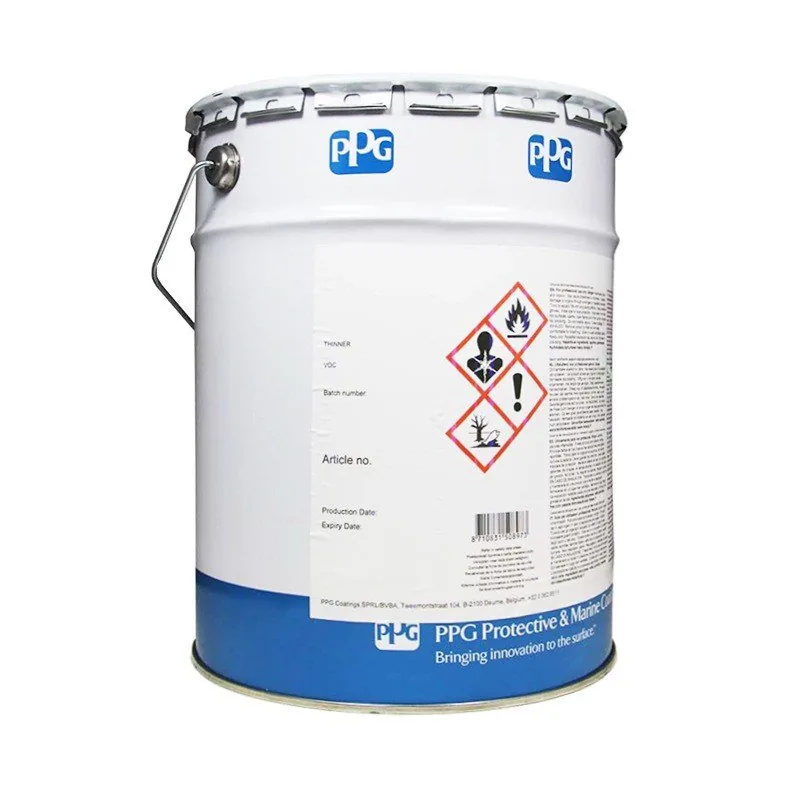
PPG HI-TEMP 222 G Heat-resistant Primer 222 G is a heat-resistant coating. One-component high-film-build composite polymer heat-resistant coating for anti-corrosive protection of insulated or directly exposed steel and stainless steel substrates; withstands substrate temperatures up to 204°C (400°F). Complies with NACE SPO-198-10 CS-1, CS-3 and CS-4 requirements for corrosion protection under insulation. Specifications on this page: volume solids 50 ± 2%, DFT 100-250 µm (4.0-10.0 mil) depending on system requirements, theoretical spreading rate 5.0 m²/L.
Parameter source: PPG manufacturer's Technical Data Sheet (TDS) "PPG HI-TEMP 222 G Heat-resistant Primer 222 G"; values such as spreading rate are converted from TDS parameters and are for product selection reference only.
The above content is compiled from the manufacturer's datasheet and this site's parameter tables. For selection, coating systems and lead times, pleaseContact Usfor confirmation.
This page carries the full TDS for this product, translated from the manufacturer's original document. No file download is needed; for an original-language copy, send an enquiry.
| Volume Solids | 50 ± 2% |
|---|---|
| Dry Film Thickness | 100–250 µm (4.0–10.0 mil) depending on the coating system requirements |
| Theoretical Spreading Rate | 5.0 m²/L |
| VOC | Maximum 265.0 g/kg (EU Directive 1999/13… |
| Density / Specific Gravity | 1.8 kg/L (15.1 lb/US gal) |
| Number of Components | One-component |
| Thinner | Application at ambient temperature 0–5%; application on hot surfaces: 0–10%… |
| Drying Time | 18 h |
One-component high-build composite polymer heat-resistant coating, used as an anticorrosive coating under thermal insulation or directly on bare steel and stainless steel substrates, resistant to substrate temperatures up to 204°C (400°F); on stainless steel substrates the service temperature ranges from cryogenic -185°C to 204°C (-300°F to 400°F). Also used as primer in coating systems with HI-TEMP series heat-resistant topcoats, and as primer with heat-resistant insulation coating 707HB (spray-applied thermal insulation).
| Number of Components | One-component |
| Density | 1.8 kg/L (15.1 lb/US gal) |
| Volume solids | 50 ± 2% |
| VOC (as supplied) | Maximum 265.0 g/kg (EU Directive 1999/13/EC, SED) |
Maximum 372.0 g/L (approx. 3.1 lb/gal) (theoretical calculated value)
| Heat resistance temperature (continuous service temperature) | Up to 204°C (400°F) |
| Peak temperature (intermittent short-term temperature) | Up to 232 °C (450 °F) |
| Severe cold and freezing environments | -185°C (-300°F) to 204°C (400°F) |
| Recommended dry film thickness | 100–250 µm (4.0–10.0 mil), depending on coating system requirements |
| Theoretical Spreading Rate | 5.0 m²/L at 100 µm (200 in²/US gal at 4.0 mil) |
| Touch Dry | 2 h |
| Drying time before topcoat application | 18 h |
| Hard Dry | 24 h |
| Storage shelf life | At least 12 months when stored in a cool, dry environment |
treatment also requires grinding and chamfering: smooth welds and round edges. Dry abrasive blast cleaning to SSPC SP 6 "Commercial Blast Cleaning" (equivalent to ISO-8501-1 Sa2), with surface roughness of 38 to 63 µm (1.5 to 2.5 mil). Wet abrasive blast cleaning or ultra-high pressure water jetting with abrasive addition achieving the equivalent of SSPC SP 6 (equivalent to ISO-8501-1 Sa2) is also acceptable.
Note: where abrasive blast cleaning is not feasible on site, power tool cleaning to SSPC SP 11 is acceptable, with surface roughness of not less than 25 µm (1.0 mil).
contaminants, particularly soluble salts, shall be removed. Structural treatment also requires grinding and chamfering, smoothing welds and rounding edges.
detergent steam cleaning, followed by fresh water rinsing. The water source shall be at least potable pure water, and products with the lowest possible salt content shall be selected.
No chemical additives shall be added to the water.
brush-off blast cleaning with chloride-free abrasive is a suitable surface preparation option. After such mechanical surface preparation, cleaning the surface with potable pure water or deionized water is preferable. Application shall proceed only after the surface is completely dry.
Application under thermal insulation or on hot surfaces [66°C (150°F) to 204°C (400°F)] - one coat
Application under thermal insulation or on hot surfaces [66°C (150°F) to 204°C (400°F)] - two coats
As a primer/topcoat coating system, it can be applied at ambient temperature or directly to hot surfaces [66°C (150°F) to 149°C (300°F)].
Coating systems used as primer/topcoat can be applied directly to hot substrate surfaces at temperatures from 149°C (300°F) to 204°C (400°F).
application, keep stirring without interruption to prevent possible settling and caking of heavy pigments at the bottom.
application), similar to a mist coat sealing porous coatings, which prevents blistering while avoiding pinholes in the film caused by slow solvent evaporation. Unless proprietary Thinner 21-25 or HI-TEMP Thinner 5 is used, other thinners may present a fire risk and cause application defects such as dry spray and poor film formation. If blistering occurs when HI-TEMP Heat-resistant Primer 222 G is applied to hot substrates, immediately level the film with a natural bristle brush with wooden handle while the wet film is still flowable. Note that the higher the substrate surface temperature, the shorter the recoat interval.
Recommended thinner — for application on substrate surfaces below 66 °C (150 °F).
Recommended thinner – application directly on hot substrates at temperatures from 66°C (150°F) to 204°C (400°F)
| Thinner quantity | Application at ambient temperature: 0–5%; application on hot surfaces: 0–10%, depending on film thickness and site application conditions. |
|---|---|
| Nozzle tip size | 1.8–2.2 mm (approx. 0.070–0.087 in) |
| Nozzle pressure | 0.4–0.6 MPa (approx. 4–6 atm; 58–87 psi) |
Recommended thinner — for application on ambient-temperature substrate surfaces below 66 °C (150 °F)
Recommended thinner – application on hot substrate surfaces at temperatures from 66°C (150°F) to 204°C (400°F):
| Thinner quantity | Application at ambient temperature: 0–5%; application on hot surfaces: 0–10%, depending on film thickness and site application conditions. |
|---|---|
| Nozzle tip size | Approx. 0.48–0.53 mm (0.019–0.021 in) |
| Nozzle pressure | 5.2–8.3 MPa (approximately 52–83 atm; 754–1204 psi) |
Recommended thinner – application directly on hot substrate surfaces at temperatures from 66°C (150°F) to 204°C (400°F)
| Thinner quantity | Application at ambient temperature: 0–5%; application on hot surfaces: 0–10%, added by this volume ratio if required on site. Note: spray application is the preferred method; brush and roller application may be considered only where site conditions make spraying impossible. Use quality brushes or short-nap rollers for manual application. Brush and roller application should proceed with even pressure and forward motion in one direction, which also helps achieve the required film thickness. |
|---|
| Dry Film Thickness | Theoretical Spreading Rate |
| 100 µm (4.0 mils) | 5.0 m²/L (200 in²/US gal) |
| 125 µm (5.0 mils) | 4.0 m²/L (160 in²/US gal) |
| 200 µm (8.0 mils) | 2.5 m²/L (100 in²/US gal) |
| 250 µm (10.0 mils) | 2.0 m²/L (80 in²/US gal) |
| Subsequent coat for recoating | Recoat interval | 10°C (50°F) | 20°C (68°F) | >150°C(300°F) |
| HI-TEM Series | Minimum recoat interval | 18 h | -- | |
| Heat-resistant Topcoat 500 VS | Maximum recoat interval | 3 months | ||
| HI-TEMP Series | Minimum recoat interval | -- | 15 min | |
| Heat-resistant Topcoat 500 VHA | Maximum recoat interval | -- | 3 months | |
| Self-recoat | Minimum recoat interval | 18 h | 6 h | -- |
| Maximum recoat interval | 3 months | |||
| Notes | When applied to bare steel surfaces without thermal insulation, dry film thickness values shall not exceed this specified range. |
|---|
| Substrate Temperature | Drying time before overcoating with the next coat/topcoat | Hard dry/walk-on dry time |
| 10 °C (50 °F) | 4 h | 48 h |
| 20 °C (68 °F) | 2 h | 24 h |
| 121 °C (250 °F) | -- | |
After reviewing the MSDS, apply the coating in accordance with the familiarised requirements. Before contact with this product, read the MSDS carefully from a health and safety standpoint to fully grasp the relevant information. All handling, application and disposal of this product must comply with national and local laws and regulations on health, safety and environmental protection, including reference to and implementation of valuable practical experience and recognised standards for safe coating application, such as SSPC PA1, Shop, Field, and Maintenance Painting of Steel.
Although PPG Protective and Marine Coatings is committed to providing completely consistent products to users worldwide, from time to time it may be necessary to make minor adjustments to specific products to comply with local/national regulations or environmental requirements. In the following cases, use the corresponding alternative version of the product data sheet instead.
PPG warrants (1) that it has good title to the product, (2) that the product quality conforms to the relevant technical quality specifications in force at the date of manufacture of the product, and (3) that the supplied product is free of lawful claims by third parties for infringement of US patent rights. The above warranties are limited to those given by PPG and other express or implied warranties required by applicable laws and regulations for transactions and commercial practice; any abuse contrary to the stated conditions, and any other warranty for special purposes or uses, are excluded, and PPG shall be free from liability. To claim under this warranty, the buyer must notify PPG in writing within five (5) days of discovering the quality defect, and the date must be within the product's valid storage period or within one (1) year from delivery of the product to the buyer.
If the buyer fails to notify PPG of the defect as required above, this will prejudice the buyer's right to obtain compensation under this warranty from PPG!
In all cases, PPG shall not be liable for any indirect, special, incidental or consequential loss of any kind arising from or in connection with the use of this product (whether based on negligence, strict liability or tort).
The information in this product data sheet is based on laboratory tests we believe to be reliable, and is provided for guidance only. PPG may revise this information at any time as experience accumulates and product development progresses.
All recommendations and advice concerning the use of this product, whether in technical documents, in response to an enquiry or otherwise, are given to the best of our knowledge and are believed to be reliable. Our products and related information are provided for industrial users possessing the necessary knowledge and practical skills, and it is the end user's responsibility to determine whether the product is suitable for the specific use. The buyer, having performed such evaluation, proceeds entirely at its own risk.
The quality and condition of the substrate on site, and the many other factors affecting product use and application, are beyond PPG's control. Therefore, PPG accepts no liability for any loss, injury or damage arising from the use of the information in this product data sheet (unless otherwise provided in a written agreement). Different application environments, changes to the application process or extrapolation of the reference data may result in failure to achieve the expected coating quality.
This product data sheet supersedes all previous versions. The buyer is responsible for confirming that the data sheet in hand is the latest version before using the product. The latest version is published on the official website of PPG Protective & Marine Coatings:
www.ppgpmc.com. In case of discrepancy between the Chinese version and the original English version of the product data sheet, the English original shall prevail.
The PPG Logo, Bringing innovation to the surface., and other PPG marks are property of the PPG group of companies. All other third-party marks are property of their respective owners.
For more Q&A on selection, application, acceptance and defect diagnosis, seeFAQsection.
Packaging specifications and batch lead times are subject to actual availability. PleaseContact Uscontact us for project-based calculation.