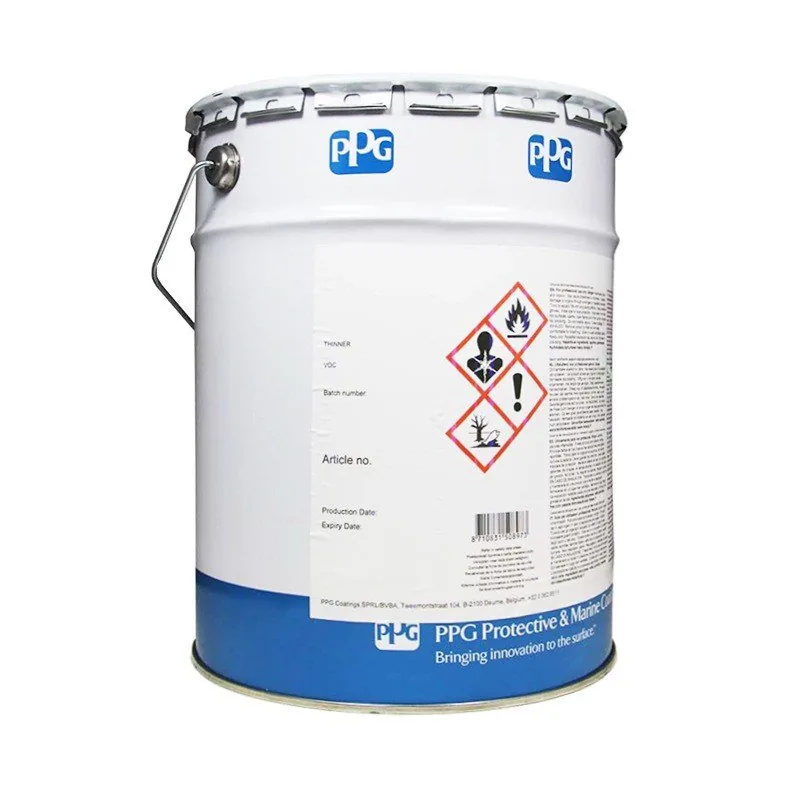
$ The above warranties are limited to those given by PPG and any other express or implied warranties required by current laws and regulations for transactions and commerce. Parameters on this page: volume solids 56% ± 2%; dry film thickness 50–60 µm depending on coating system; theoretical spreading rate 11.2 m²/L. Comparable products from the same brand: AMERCOAT 114 A Epoxy Filler 114 A, AMERCOAT 220 Waterborne Acrylic Topcoat 220, AMERCOAT 240 SIGMACOVER 240 High-solids Multipurpose Epoxy 240.
Source: PPG original technical data sheet (TDS) 'PPG SIGMADUR 188 Polyurethane Topcoat 188'. Spreading rate and other values converted from the TDS; for reference only.
The above content is compiled from the manufacturer's datasheet and this site's parameter tables. For selection, coating systems and lead times, pleaseContact Usfor confirmation.
This page carries the full TDS for this product, translated from the manufacturer's original document. No file download is needed; for an original-language copy, send an enquiry.
| Volume Solids | 56% ± 2% |
|---|---|
| Dry Film Thickness | 50–60 µm, depending on coating system |
| Theoretical Spreading Rate | 11.2 m²/L |
| VOC | — |
| Density / Specific Gravity | Approx. 1.2 g/cm³ |
| Number of Components | — |
| Thinner | - 10%, depending on application conditions and the required film thickness |
| Colour / Appearance | Gloss |
| Pot Life | At 20 °C * |
The manufacturer's datasheet for this model does not state the coating position or resin type, so it has not been assigned to the above categories. Browse similar products by category, orContact Usconfirm the coating system.
Page 5, November 2012, revised November 2005
| Description | A two-component aliphatic acrylic polyurethane topcoat | |
| Key properties | – | No recoat limitation |
- High weathering resistance - High gloss and colour retention - No chalking or yellowing - Cures at temperatures down to -5 °C - Tough and abrasion-resistant - Resistant to splash contamination from mineral oil, vegetable oil, white spirit, paraffin, aliphatic petroleum products and mild chemicals.
–
- Recoatable even after long-term atmospheric exposure
| Colour and gloss | White and black, with other colours available on request. - | Gloss |
| Basic data at 20 °C | (1 g/cm³ = 8.35 lb/US gal; 1 m²/L = 40.7 ft²/US gal) |
(data after mixing)
| density | Approx. 1.2 g/cm³ |
| Volume Solids | 56% ± 2% |
| VOC content (UK PG | Max 398 g/L (approx. 3.3 lb/gal) |
6/23(92) Annex 3)
| Recommended dry film thickness | 50–60 µm, depending on coating system | |
| Theoretical Spreading Rate | 11.2 m²/L at 50 µm | |
| Touch dry time | 1 h | At 20 °C |
| Recoat Interval | Minimum: 6 h. *Maximum: unlimited | |
| Full cure time | 4 days | (component data) |
| Shelf life (cool, dry place) | At least 24 months. *See attached table | |
| Recommended substrate condition and temperature | - Previous coat: the surface (epoxy or polyurethane) should be dry and free of contaminants, and |
if necessary abrade to achieve sufficient surface roughness - Application and curing temperatures down to -5 °C are allowed provided the substrate is free of water or ice - The substrate temperature must be at least 3 °C above the dew point - Maximum 85% relative humidity during application and curing - The coating must not be exposed to rain or condensation too early, otherwise its colour and gloss will be affected
| Instructions for use | Mixing ratio by volume: base : hardener = 88:12 - After mixing base and hardener, the temperature should be above 10 °C, otherwise add thinner to reach the application viscosity. November 2012 - The thinner should be added after mixing the components - Excessive thinner reduces sag resistance |
|---|
| Induction Time | None | |
| Pot life | 5 h. See attached data | At 20 °C * |
| Recommended thinner, thinner quantity | Thinner 21-06 5 | Thinner 21-06 - 10%, depending on application conditions and the required film thickness |
| Nozzle tip size | 1.0–1.5 mm | |
| Nozzle pressure, airless spray | 0.3–0.4 MPa (= approx. 3–3 bar; 44–58 lb/in²) | |
| Recommended thinner | Thinner 21-06 | |
| Thinner quantity | 8 | - 15%, depending on application conditions and the required film thickness |
| Nozzle tip size | 0.28–0.33 mm (= 0.011–0.013 in) | |
| Nozzle pressure, brush/roller | 20 MPa (= approx. 200 bar; 2901 lb/in²) | |
| Recommended thinner | Thinner 21-06 | |
| Thinner quantity | 5 - 10% | |
| Cleaning solvent | Thinner 90-53. Film thickness and spreading rate |
Theoretical spreading rate m²/L: 11.2, 9.3. Dry film thickness µm: 50, 60. Polyurethane Topcoat 188 recoat interval table. Substrate temperature: -5 °C, 0 °C, 10 °C, 20 °C, 30 °C, 40 °C. Minimum recoat interval: 24 h, 16 h, 8 h, 6 h, 5 h, 3 h. Maximum recoat interval: unlimited. - The surface should be dry and free of contaminants. November 2012
| Curing | Curing time table. Substrate temperature, hard dry, fully cured: -5 °C 24 h 15 days; 0 °C 16 h 11 days; 10 °C 8 h 6 days; 20 °C 6 h 4 days; 30 °C 5 h 3 days; 40 °C 3 h 2 days. - During application and curing, ensure continuous and adequate ventilation (refer to sheets 1433 and 1434) - The coating must not be exposed to rain or condensation too early, otherwise its colour and gloss will be affected. Pot life (at application viscosity): 10 °C 6 h; 20 °C 4 h; 30 °C 3 h; 40 °C 2 h. |
|---|---|
| Application Methods | - Polyurethane topcoats have high gloss and thin film, and ideal atomization is not easy to achieve - High-pressure airless spray is widely used for such topcoats, but improper configuration of small nozzle and high pressure can easily cause over-thick film. |
- A better application method is air spray with a pressurized lid or pressure feed (e.g. Airmix), which controls dry film thickness better, improves the surface appearance and reduces overspray.
| Worldwide applicability | Although PPG always strives to supply identical products to users worldwide, sometimes minor adjustments to specific products are required to comply with local/national regulations or environmental conditions. |
|---|
In the following cases, use the targeted alternative version of the product datasheet.
November 2012
| Reference | Product data: refer to sheet 1411. Confined space safety and health, explosion hazard - toxic hazard: refer to sheet 1431. Ventilation technical guidance: refer to sheet 1434. Safety guidance: refer to information sheet 1430. Safe work in confined spaces: refer to sheet 1433. |
|---|---|
| Safety Precautions | - For the coating and its recommended thinners, refer to safety data sheets 1430, 1431 and the related material safety data sheets - This is a solvent-borne coating; avoid inhaling spray mist and solvent vapour, and avoid skin and eye contact with wet paint. |
- Contains toxic polyisocyanate hardener - Avoid inhaling spray mist. November 2012
PPG warrants (1) ownership of the product name, (2) that the product quality conforms to the relevant technical quality specification in effect on the product's production date, and (3) that the supplied product is free from valid third-party claims of infringement of US patents. $ The above warranties are limited to those given by PPG and any other express or implied warranties required by current laws and regulations for transactions and commerce; misuse beyond the specified restrictions, and any other warranty for a particular purpose or use, are excluded, and PPG is released from claim liability. $ To claim under this warranty, the purchaser must notify PPG in writing within 5 days of discovering the quality problem, and within the product's valid storage period or within 1 year of delivery to the purchaser, whichever applies. If the purchaser fails to notify PPG of the defect as required above, it may hinder any claim for compensation under this warranty.
In all cases, PPG shall not be liable for any indirect, special, incidental or consequential losses arising from or caused by the use of this product (whether based on negligence, strict liability or tort). The information in this datasheet is based on laboratory tests we believe reliable, but is for reference guidance only. As experience accumulates and product development progresses, PPG may revise the above information at any time. All recommendations and advice regarding the use of this product, whether in technical documents, in response to an enquiry or otherwise, are given to the best of our knowledge and are believed reliable. The products and related information are provided for industrial users with the necessary knowledge and practical skills; the end user is responsible for determining whether the product is suitable for the specific use. Accordingly, the purchaser, having performed such evaluation, shall have full discretion and assume the corresponding risk. The quality and condition of the on-site substrate and many other factors affecting product use and application are beyond PPG's control. Therefore, PPG accepts no liability for any loss, injury or damage arising from the use of the information in this datasheet (unless otherwise provided in a written agreement). Different application environments, changes to the coating process or assumed reference data may all lead to failure to achieve the expected coating quality. This product datasheet supersedes all previous versions; the purchaser is responsible for confirming that the datasheet in hand is the latest version before use. The current latest version is published on the official website of PPG Protective and Marine Coatings: www.ppgpmc.com. In case of discrepancy between the Chinese and English versions, the English original prevails.
Product datasheet 6824
Data is subject to the manufacturer's latest version; in all cases the manufacturer's latest TDS prevails.
For more Q&A on selection, application, acceptance and defect diagnosis, seeFAQsection.
Packaging specifications and batch lead times are subject to actual availability. PleaseContact Uscontact us for project-based calculation.