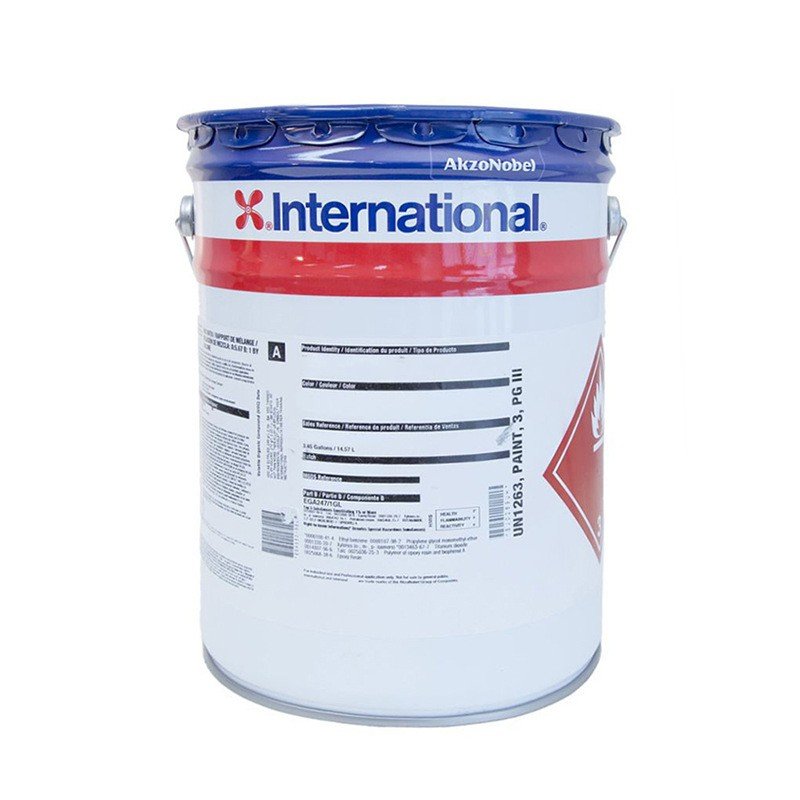
Intershield 456 High-solids Epoxy Primer belongs to epoxy coatings and is used as a primer. Developed to meet the requirements of MIL-PRF-24667, Type I, II and V, Composition G and L primer systems. Parameters on this page: volume solids 84% ± 2% (ASTM D2697-86), dry film thickness 125 µm, theoretical spreading rate 6.72 m²/L. Comparable models of the same brand: Interbond 201 - Temperate Epoxy Primer, Interbond 808 Epoxy Anticorrosive Paint, Intergard 5101 Epoxy General-purpose Primer.
Source: International original technical data sheet (TDS) "Intershield 456 High-solids Epoxy Primer"; spreading rate and other values are converted from TDS parameters and are for selection reference only.
The above content is compiled from the manufacturer's datasheet and this site's parameter tables. For selection, coating systems and lead times, pleaseContact Usfor confirmation.
This page carries the full TDS for this product, translated from the manufacturer's original document. No file download is needed; for an original-language copy, send an enquiry.
| Volume Solids | 84% ± 2% (ASTM D2697-86) |
|---|---|
| Dry Film Thickness | 125 µm |
| Theoretical Spreading Rate | 6.72 m²/L |
| VOC | 120 g/L (as supplied) (1.00 lb/US gal) (EPA Meth… |
| Density / Specific Gravity | — |
| Number of Components | Two-component |
| Mixing Ratio | Component A : Component B = 3:1 (by volume) |
| Colour / Appearance | EGA600 orange, EGA602 pale yellow |
| Gloss | N/A |
For more Q&A on selection, application, acceptance and defect diagnosis, seeFAQsection.
A high-solids epoxy primer. Developed to meet the requirements of MIL-PRF-24667, Types I, II and V, Composition G and L primer systems.
For newbuilding, maintenance and repair, or in-service maintenance.
As the primer for Intershield 6GV, Intershield 6LV or Intershield 5150LWT non-slip deck coatings.
| Colour | EGA600 orange, EGA602 pale yellow |
|---|---|
| Topcoat/gloss | N/A |
| Component B (curing agent) | EGA601 |
| Volume Solids | 84% ±2% (ASTM D2697-86) |
| Mixing ratio | Component A : Component B = 3:1 (by volume) |
| Standard film thickness | 125 µm dry film (149 µm wet film); practical dry film range 100–175 µm, equivalent to 119–208 µm wet film |
| Theoretical Spreading Rate | At 125 µm dry film, theoretical spreading rate is 6.72 m²/L, allowing an appropriate loss factor |
| Application Methods | Airless spray, brush, roller |
| Flash Point | Component A 43 °C; Component B 52 °C; mixed 43 °C |
| Induction Time | 15 min at temperatures below 23 °C |
| Drying data | 10°C | 25°C | 35°C |
| Hard dry [ASTM D1640 7.7] | 20 h | 8 h | 5 h |
| Pot life after mixing | 105 min | 60 min | 30 min |
| Recoat data — see the “Limitations” section | Substrate Temperature | |||||
| 10°C | 25°C | 35°C | ||||
| When recoating the following products | Minimum | Maximum | Minimum | Maximum | Minimum | Maximum |
| Intershield 456 | 24 h | 72 h | 8 h | 72 h | 5 h | 72 h |
| Intershield 5150LWT | 24 h | 72 h | 8 h | 72 h | 5 h | 72 h |
| Intershield 6GV | 24 h | 72 h | 8 h | 72 h | 5 h | 72 h |
| Intershield 6LV | 24 h | 72 h | 8 h | 72 h | 5 h | 72 h |
| Interthane 990 | 24 h | 5 days | 8 h | 5 days | 5 h | 5 days |
| Interthane 990HS | 24 h | 5 days | 8 h | 5 days | 5 h | 5 days |
| Note | Drying times and pot life vary with ambient temperature and/or humidity. |
|---|
| Volatile Organic Compounds | 120 g/L (as supplied) (1.00 lb/US gal) (EPA Method 24). VOC values are typical values provided for reference only. They may vary with factors such as colour and normal manufacturing tolerances. |
|---|---|
| Military specification | MIL-PRF-24667C Type VII, Groups G and L. MIL-PRF-24667C Types I, II, V, Groups G and L |
For the paint system best suited to the surface to be protected, consult your local International Paint representative.
For other information, refer to the International Paint application procedure.
Typical systems: Intershield 456/Intershield 6GV. Intershield 456/Intershield 6GV/Interthane 990. Intershield 456/Intershield 6GV/Interthane 990HS. Or Intershield 456/Intershield 6LV. Intershield 456/Intershield 6LV/Interthane 990. Intershield 456/Intershield 6LV/Interthane 990HS. Or Intershield 456/Intershield 5150LWT. Intershield 456/Intershield 5150LWT/Interthane 990. Intershield 456/Intershield 5150LWT/Interthane 990HS
Paint only on clean, dry surfaces. Remove all grease, oil, soluble contaminants and other foreign matter by solvent cleaning per SSPC-SP1.
Steel: for ideal performance, "near-white blast cleaning" (SSPC-SP10) is recommended.
High-pressure water derusting to International Paint HB2½L (SSPC WJ2) standard, with slight flash rusting acceptable.
A surface roughness of at least 75 µm is required.
If oxidation occurs between blasting and application of Intershield 456, re-blast to the specified standard.
Where abrasive blasting is not possible, use "power-tool cleaning" (SSPC-SP11).
Aluminium: for aluminium and light alloy surfaces, solvent-clean per SSPC-SP1, then physically phosphating-treat by abrasive blasting.
For specific advice, consult your local International Paint representative.
Note: for marine environments outside North America, the following surface preparation standards may be used: Sa 2.5 (ISO 8501-1:2007) instead of SSPC-SP10; Pt3 (JSRA SPSS:1984) instead of SSPC-SP11; St3 (ISO 8501-1:2007) instead of SSPC-SP11.
Apply by brush, roller or spray.
Apply the mixed coating as a smooth, even film on suitably prepared surfaces by brush, roller or spray.
Applying a 150 µm wet film produces a 125 µm dry film. Recoat intervals must be observed. If the maximum recoat interval is exceeded, the surface must be abraded before applying the subsequent coat.
See the introductions for the following equipment:
Do not weigh out and mix the coating until ready for use. The coating is supplied in two containers as a kit. Always mix the entire kit in the supplied proportions when using. (1) Stir component A with a power stirrer. (2) Mix all of component A and component B and stir thoroughly with a power stirrer. (3) Below 23 °C, the coating should have a 15-minute "induction" period. Do not mix freshly mixed coating with coating nearing the end of its pot life.
Do not thin
Pump with minimum ratio 56:1; nozzle tip 0.017–0.023 in (432–584 µm); high-pressure paint hose with 3/8 in (9.5 mm) internal diameter; 60-mesh nozzle filter.
N/A
Use a Chinese hog-bristle brush of a suitable size.
Brush application is recommended for small areas only. Several coats may be required to achieve the specified film thickness.
Use a multipurpose roller sleeve with 3/8 in (9.5 mm) smooth-to-medium nap. Pre-clean the roller sleeve before use to remove loose fibres.
Roller application is recommended for small areas only. Several coats may be required to achieve the specified film thickness.
International GTA220/GTA415
Clean all equipment immediately after use with International GTA220/GTA415. Periodic flushing of spray equipment during the working day is good practice. The number of flushings depends on the quantity sprayed, temperature and time used (including delays). Do not exceed the pot life of the coating.
All surplus paint and empty containers must be disposed of in accordance with appropriate local regulations/laws.
If welding or flame cutting is performed on metal coated with this product, dust and fumes will be released; use suitable personal protective equipment and local exhaust ventilation. In North America, follow the instructions in ANSI/ASC Z49.1 “Safety in Welding and Cutting”.
All work related to the application and use of this product must comply with national health, safety and environmental protection standards and regulations.
Before using this product, obtain, read and follow the health and safety information in the Material Safety Data Sheet for the product. Read and observe all precautions in the Material Safety Data Sheet and on the container label. If these warnings and requirements are not fully understood, or cannot be strictly observed, do not use the product. During application and drying of the product, provide adequate ventilation and protective measures to keep solvent vapour concentrations within safe limits, so as to prevent poisoning or oxygen deficiency. Take protective measures to avoid skin and eye contact with the product (e.g. gloves, goggles, face shield, barrier cream). Specific safety measures depend on the application method and working environment.
Emergency contact: USA/Canada — medical 1-800-854-6813; Europe — tel. (44) 191 4696111, hospital and doctor (44) 207 6359191; China — tel. (86) 532 83889090; other regions — contact the regional office.
Apply in good weather, with air and surface temperatures above 10 °C. The surface temperature shall be at least 3 °C above the dew point. For optimum performance, bring the paint temperature to 21–27 °C before mixing and application.
Recoat data are for guidance only and depend on local climatic and environmental conditions. For specific advice, consult your local International Paint representative.
The technical and application data given here are intended as general guidance for establishing an application procedure. Test results are obtained in a controlled laboratory environment, and International Paint does not claim that the published test results, or any other test results, accurately represent results obtained in all site environments.
Because application, environmental and design parameters vary widely, care must be exercised in coating selection, performance verification and use.
| Packaging Specifications | Component A | Component B | ||
| Volume | Packaging | Volume | Packaging | |
| 4 US gal | 3 US gal | 5 US gal | 1 US gal | |
For other packaging sizes, consult International Paint.
| Packaging Specifications | Packaging weight |
|---|---|
| 4 US gal | 55 lb |
| Shelf life | 12 months from the production date when stored in a protected environment at 4–38 °C. Re-inspection required thereafter. Store in a cool, dry place, away from heat sources and sources of ignition. |
|---|
Please consult INTERNATIONAL.
The information given in this product data sheet is not exhaustive. Anyone who uses, for any reason, any product other than those specifically recommended in this data sheet without first obtaining our written confirmation does so at their own risk as regards the suitability of the product for the intended purpose. Although we make every effort to ensure that all advice we give about the product (whether in this data sheet or otherwise) is correct, we cannot control the quality or condition of the substrate, nor the many factors affecting the application and use of this product. Accordingly, unless we specifically agree otherwise in writing, we accept no liability, to the maximum extent permitted by law, for any product performance problem arising, or for any loss or damage caused by use of the product. We therefore disclaim all warranties, express or implied, arising by operation of law or otherwise, including but not limited to any implied warranty of merchantability or fitness for a particular purpose. All products supplied and all technical guidance provided are subject to our terms and conditions of sale. You should obtain a copy of this document and read it carefully. The information contained in this product data sheet may be amended at any time in the light of experience and of our continuing product development policy. Before using the product, it is the user's responsibility to check with the local representative that the data sheet in their possession is the latest version.
This technical data sheet is also available on our websites www.international-marine.com and www.international-pc.com, and should be consistent with this document. If there is any discrepancy between this document and the version of the technical data sheet on the website, the version on the website shall prevail.
© AkzoNobel, 2015www.international-marine.com
Data is subject to the manufacturer's latest version; in all cases the manufacturer's latest TDS prevails.
Packaging specifications and batch lead times are subject to actual availability. PleaseContact Uscontact us for project-based calculation.