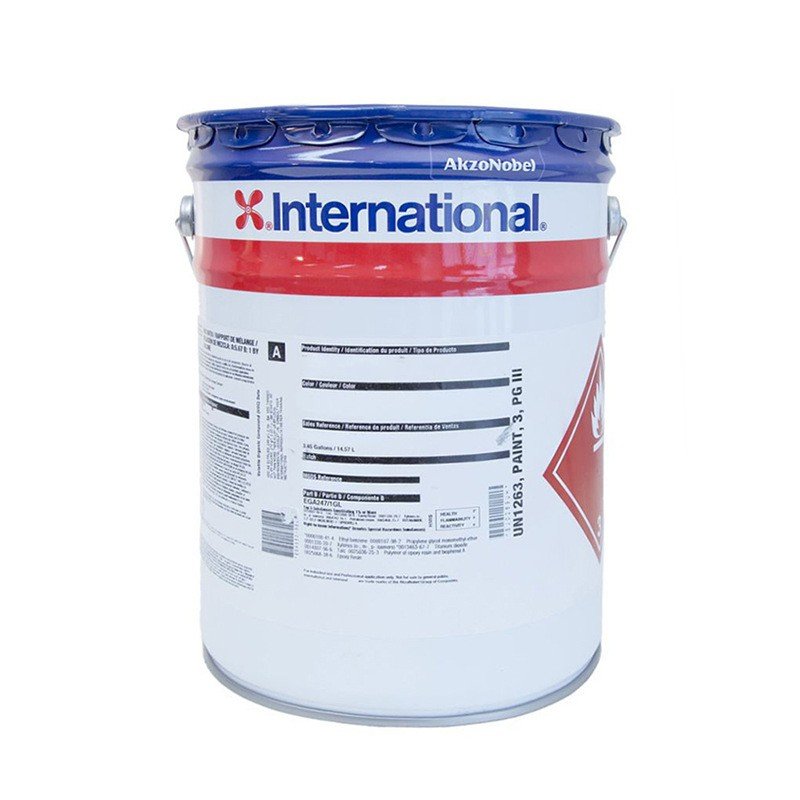
For newbuildings, maintenance or in-service maintenance. An easy-clean, one-component, high-solids silicone alkyd topcoat containing low solar absorption (LSA) pigment. Parameters on this page: volume solids 60% (ASTM D2697-86), dry film thickness 50 µm, theoretical spreading rate 12 m²/L. Comparable products from the same brand: Interbond 201 – Low Temperature Epoxy Primer/Topcoat, Intercryl 559 Smooth Washable Topcoat, Intergard 7020 Abrasion-resistant Aluminium-flake Pure Epoxy.
Source: International original technical data sheet (TDS) "Interlac 1 Silicone Alkyd Topcoat"; spreading rate and other values are converted from TDS parameters and are for selection reference only.
The above content is compiled from the manufacturer's datasheet and this site's parameter tables. For selection, coating systems and lead times, pleaseContact Usfor confirmation.
This page carries the full TDS for this product, translated from the manufacturer's original document. No file download is needed; for an original-language copy, send an enquiry.
| Volume Solids | 60% (ASTM D2697-86) |
|---|---|
| Dry Film Thickness | 50 µm |
| Theoretical Spreading Rate | 12 m²/L |
| VOC | 336 g/L (as supplied) (EPA Method 24) 253 g/kg (… |
| Density / Specific Gravity | — |
| Number of Components | One-component |
| Colour / Appearance | 45587A smoke grey |
| Gloss | Semi-gloss |
| Packaging Specifications | Packaging weight |
The manufacturer's datasheet for this model does not state the coating position or resin type, so it has not been assigned to the above categories. Browse similar products by category, orContact Usconfirm the coating system.
For more Q&A on selection, application, acceptance and defect diagnosis, seeFAQsection.
An easy-clean, one-component, high-solids silicone alkyd topcoat containing low solar absorption (LSA) pigment. The active pigment minimises rust spotting and highlights corrosion areas needing repair. Compared with ordinary silicone alkyd topcoats, it has higher performance and lower heat absorption. Excellent colour and gloss retention. Easy to apply and recoat. Low VOC content.
For freeboards, superstructures and deck fittings.
For newbuilding, maintenance and repair, or in-service maintenance.
| Colour | 45587A smoke grey |
|---|---|
| Topcoat/gloss | Semi-gloss |
| Component B (curing agent) | One-component |
| Volume Solids | 60% (ASTM D2697-86) |
| Standard film thickness | 50 µm dry film (83 µm wet film). Standard film range 50–63 µm dry film (83–105 µm wet film) |
| Theoretical Spreading Rate | At 50 µm dry film, theoretical spreading rate is 12 m²/L, allowing an appropriate loss factor |
| Application Methods | Airless spray, roller, brush, conventional spray |
| Flash Point | One-component 40 °C (Setaflash) (ASTM D-3278) |
| Drying data | 10°C | 15°C | 25°C | 35°C |
| Touch dry [ASTM D1640 7.5.1] | 6 h | 4 h | 2 h | 60 min |
| Hard dry [ASTM D1640 7.7] | 14 h | 11 h | 8 h | 6 h |
| Recoat data — see the “Limitations” section | Substrate Temperature | |||||||
| 10°C | 15°C | 25°C | 35°C | |||||
| When recoating the following products | Minimum | Maximum | Minimum | Maximum | Minimum | Maximum | Minimum | Maximum |
| Interlac 1 | 32 h | Unlimited | 29 h | Unlimited | 24 h | Unlimited | 16 h | Unlimited |
| Volatile Organic Compounds | 336 g/L (as supplied) (EPA Method 24) 253 g/kg (as supplied liquid paint). EU Solvent Emissions Directive (Commission Directive 1999/13/EC). VOC values are typical values provided for reference only. They may vary with factors such as colour and normal manufacturing tolerances. |
|---|---|
| Military specification | MIL-PRF-24635C, Type II Class 2, Grade C LSA antifouling |
Interlac 1 must be applied over the recommended primer system, which depends on the vessel area and supply region.
Generally, when coating large vessel areas in the US, Interlac 1 may be applied over epoxy primers per MIL-P-23236 or MIL-DTL-24441. For smaller vessel areas, Interlac 1 may also be applied over alkyd primers.
Direct application is acceptable over the following marine anticorrosive paints: Intergard 264 (per MIL-P-23236), Formula 150 Primer (per MIL-DTL-24441 Type III), Formula 150 Primer (per MIL-DTL-24441 Type IV), Interprime 198, Interprime 298, Intertuf 262, and alkyd primers complying with TT-P-645 military certificate. When applying over other epoxy anticorrosive primers, one coat of Intergard 263 tie coat shall be applied before Interlac 1. In Europe, for above-water areas, Intergard 162 may be used instead of Intergard 263.
For the paint system best suited to the surface to be protected, consult your local International Paint representative.
Apply only to clean, dry surfaces. Remove all grease, oil, soluble contaminants and other foreign matter in accordance with the solvent cleaning standard (SSPC-SP1).
Uncoated surfaces: carry out surface preparation and apply the recommended primer. Apply one or more coats of Interlac 1 as specified. (For surface preparation and recoat information, refer to the relevant primer product data sheet.) Previously painted surfaces: use "hand or power-tool cleaning" (SSPC-SP2 or SP3 respectively) to remove all mill scale, loose rust, loose paint and other foreign matter.
Abrade all hard and glossy surfaces to a dull finish by sanding or "brush-off blasting" (SSPC-SP7). Apply primer locally to bare areas as recommended and apply one or more coats of Interlac 1 as specified. For surface preparation and recoat information, refer to the relevant primer product data sheet. Check the integrity of the existing coating system and carry out a representative small-patch test to confirm compatibility. For specific procedures, consult the local International Paint representative.
Note: for marine environments outside North America, the following surface preparation standards may be used: St2 (ISO 8501-1:2007) instead of SSPC-SP2; St3 (ISO 8501-1:2007) instead of SSPC-SP3.
Apply by conventional spray or airless spray. Other application methods, such as brush or roller, may require more than one coat and are recommended only for small areas. Before application, filter through a sieve of at least 60 mesh. Applying an 83 µm wet film produces a 50 µm dry film. Consult the following equipment profiles or use suitable equivalent equipment.
This coating is a single-component product; stir thoroughly with a power mixer before application.
Do not exceed the thinning limits of your country. The coating is supplied at spraying viscosity and normally requires no thinning. If thinning is necessary, use a maximum of 4 oz (118 ml) of International GTA004 per gallon of paint.
Pump with minimum ratio 28:1; nozzle tip 0.013–0.017 in (330–432 µm); high-pressure paint hose with 3/8 in (9.5 mm) internal diameter; 60-mesh nozzle filter.
DeVilbiss MBC-510 spray gun, E tip and 704 air cap; paint hose with 3/8 in (9.5 mm) internal diameter; dual-regulated pressure pot with oil/water separator.
Use a Chinese hog-bristle brush of a suitable size.
Use a multipurpose roller sleeve with 3/8 in (9.5 mm) smooth-to-medium nap. Pre-clean the roller sleeve before use to remove loose fibres.
International GTA004
Clean all equipment immediately after use with International GTA004. Periodic flushing of spray equipment during the working day is good practice. The number of flushings depends on factors such as the quantity sprayed, temperature and time used (including stoppages). Pay close attention to the condition of the coating. All leftover paint and empty containers shall be disposed of in accordance with the appropriate local regulations/laws.
If welding or flame cutting is performed on metal coated with this product, dust and fumes will be released; use suitable personal protective equipment and local exhaust ventilation. In North America, follow the instructions in ANSI/ASC Z49.1 “Safety in Welding and Cutting”.
All work related to the application and use of this product must comply with national health, safety and environmental protection standards and regulations.
Before using this product, obtain, read and follow the health and safety information in the Material Safety Data Sheet for the product. Read and observe all precautions in the Material Safety Data Sheet and on the container label. If these warnings and requirements are not fully understood, or cannot be strictly observed, do not use the product. During application and drying of the product, provide adequate ventilation and protective measures to keep solvent vapour concentrations within safe limits, so as to prevent poisoning or oxygen deficiency. Take protective measures to avoid skin and eye contact with the product (e.g. gloves, goggles, face shield, barrier cream). Specific safety measures depend on the application method and working environment.
Emergency contact: USA/Canada — medical 1-800-854-6813; Europe — tel. (44) 191 4696111, hospital and doctor (44) 207 6359191; China — tel. (86) 532 83889090; other regions — contact the regional office.
| Apply in fine weather with air and surface temperatures above 2 °C. | The surface temperature must be at least 3 °C above the dew point. For ideal performance, before mixing and application, |
|---|---|
| raise the coating temperature to between 21 and 27 °C. | The temperature of unmixed coating (in sealed containers) shall be kept between 4 and 38 °C under protective storage conditions. |
The performance of Interlac 1 depends on the surface cleanliness standard and the specified film thickness to be achieved.
In areas subjected to continuous running-water washing, the rust-stain resistance of this product is reduced. Not suitable for boot-top areas.
Two coats of Interlac 1 may be required to fully hide dark primers.
Recoat data are for guidance only and depend on local climatic and environmental conditions. For specific advice, consult your local International Paint representative.
The technical and application data given here are intended as general guidance for establishing an application procedure. Test results are obtained in a controlled laboratory environment, and International Paint does not claim that the published test results, or any other test results, accurately represent results obtained in all site environments.
Because application, environmental and design parameters vary widely, care must be exercised in coating selection, performance verification and use.
In the Recoat Data section, unlimited = 'ext'. See the Marine Painting Guide — Definitions and Abbreviations available on our website.
Packaging size volume; packaging
| 1 US gal | 1 US gal 1 US gal |
|---|---|
| 5 US gal | 5 US gal 5 US gal |
| 5 L | 5 L, 5 L |
| 20 L | 20 L; 20 L |
| Packaging Specifications | Packaging weight |
|---|---|
| 1 US gal | 12.2 lb |
| 5 US gal | 60.7 lb |
| 5 L | 7.4 kg |
| 20 L | 29 kg |
| Shelf life | Minimum 24 months from the production date when stored in a protected environment at 4–38 °C. Re-inspection required thereafter. |
|---|
Store in a cool, dry place away from heat and ignition sources.
Information is subject to the manufacturer's latest version; the manufacturer's latest TDS prevails.
The technical parameters on this page are taken from the product's original manufacturer technical datasheet, the copyright of which belongs to the manufacturer. If a rights holder considers the presentation inappropriate, contact us for verification and handling.
Packaging specifications and batch lead times are subject to actual availability. PleaseContact Uscontact us for project-based calculation.