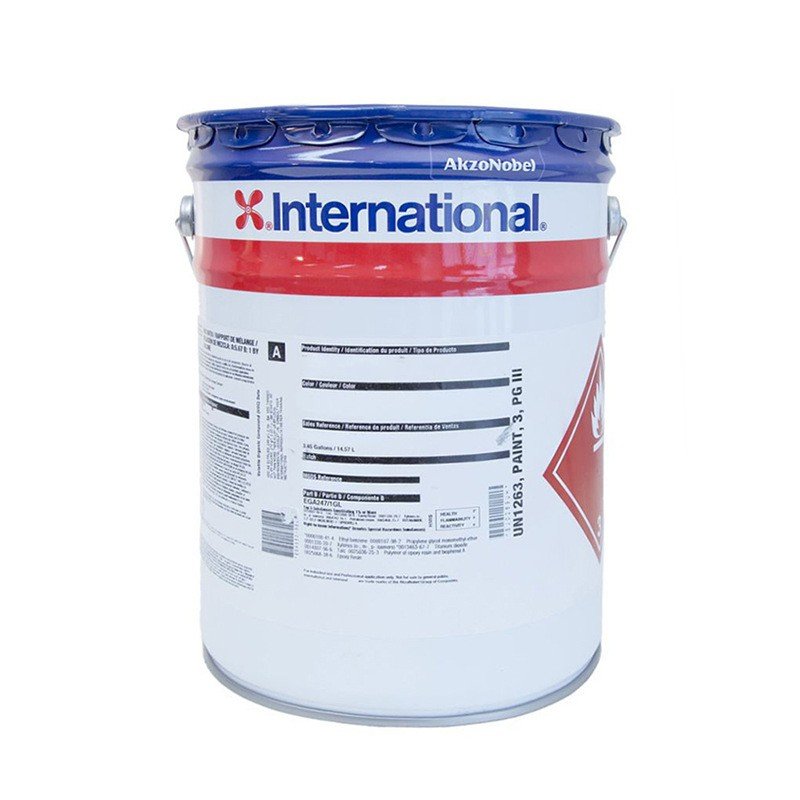
Intertherm 751CSA Heat-resistant Cold-spray Aluminium Coating is a heat-resistant coating. Intertherm 751CSA is normally applied directly to metal surfaces as a one- or two-coat system, particularly effective in maintenance, and can be used to mitigate corrosion damage under insulation (CUI). A two-component, high-build, heat-resistant coating applied by "cold spray", using inorganic polymer technology with leafing aluminium flake pigment. When applying Intertherm 751CSA by brush or roller, multiple coats are necessary to achieve the specified total system dry film thickness. Parameters on this page: dry film thickness 100–200 µm (4–8 mil), theoretical spreading rate 3.49 m²/L, number of components two.
Source: AkzoNobel original technical data sheet (TDS) "Intertherm 751CSA Heat-resistant Cold-spray Aluminium Coating"; spreading rate and other values are converted from TDS parameters and are for selection reference only.
The above content is compiled from the manufacturer's datasheet and this site's parameter tables. For selection, coating systems and lead times, pleaseContact Usfor confirmation.
This page carries the full TDS for this product, translated from the manufacturer's original document. No file download is needed; for an original-language copy, send an enquiry.
| Volume Solids | 61% |
|---|---|
| Dry Film Thickness | 100–200 µm (4–8 mils) |
| Theoretical Spreading Rate | 3.49 m²/L |
| VOC | 3.50 lb/gal (420 g/L) US EPA Method 24 3… |
| Density / Specific Gravity | 1.28 kg/L (10.7 lb/gal) |
| Number of Components | Two-component |
| Thinner | Normally no thinning is required |
| Mixing Ratio | 54 parts : 1 part (by volume) |
| Colour / Appearance | Aluminium, INTERTHERM 751CSA; gloss: not applicable |
For more Q&A on selection, application, acceptance and defect diagnosis, seeFAQsection.
A two-component, high-build, heat-resistant coating applied by "cold spray", using inorganic polymer technology with leafing aluminium flake pigment.
Intertherm 751CSA is a novel high-performance coating applied with ordinary equipment and effectively curing at ambient temperature. In atmospheric environments
| , or at −196 °C (−321 °F) and | under thermal-cycling insulated service between −196 °C (−321 °F) and 650 °C (1202 °F), it provides corrosion protection for steel without additional heat curing before being put into service. |
|---|
| Intertherm 751CSA | Specially designed to provide a corrosion barrier when protecting steel members under insulation in wet/dry alternating areas. |
|---|
Intertherm 751CSA is normally applied directly to metal surfaces as a one- or two-coat system, particularly effective in maintenance, and can be used to mitigate corrosion damage under insulation (CUI).
Intertherm 751CSA has excellent resistance to "thermal shock" under rapid temperature cycling, providing effective protection for steel members under cyclic conditions.
Intertherm 751CSA, suitable for application on hot surfaces up to 150 °C (302 °F), is suitable for industrial environments such as chemical processing, petrochemical, offshore facilities and power; particularly suitable for corrosion protection of the external walls of steel structures such as refining, chemical processing, pipelines, chimneys, valves, heat exchangers, furnaces, reactors, power plants and flue outlets. It is the ideal product for routine maintenance or large-scale refurbishment projects, where its single anti-corrosion system can be used to maintain large quantities of insulated and non-insulated pipework.
| Colour | Aluminium, INTERTHERM 751CSA; gloss: not applicable |
|---|---|
| Volume Solids | 61% |
| Typical thickness | Dry film 100–200 µm (4–8 mil), equivalent to wet film 164–328 µm (6.6–13.1 mil) |
| Theoretical Spreading Rate | At 175 µm dry film thickness and the stated volume solids, 3.49 m²/L; at 7 mil dry film thickness and the stated volume solids, 140 ft²/US gal |
| Practical Spreading Rate | Allowing for a suitable loss factor |
| Application Methods | Suitable for airless spray, air spray, brush, roller. Drying time; recommended topcoat recoat interval |
| Temperature | Surface Dry | Hard Dry | Minimum | Maximum |
| 5°C (41°F) | 2 h | 18 h | 36 h | Not applicable¹ |
| 15°C (59°F) | 90 min | 12 h | 24 h | Not applicable¹ |
| 25°C (77°F) | 60 min | 10 h | 16 h | Not applicable¹ |
| 40°C (104°F) | 30 min | 8 h | 12 h | Not applicable¹ |
¹ For topcoat recoat intervals, consult International Paint.
| Flash point (typical) | Component A 32 °C (90 °F); Component B 22 °C (72 °F); mixed 25 °C (77 °F) |
|---|---|
| Product weight | 1.28 kg/L (10.7 lb/gal) |
| Volatile Organic Compounds | 3.50 lb/gal (420 g/L) US EPA Method 24. 332 g/kg. EU Solvent Emissions Directive (EU Council Directive 2010/75/EU). 405 g/L. Chinese national standard GB 23985. Coating hazards: GB 30981.2-S-Pb≤1000-NC. Complies with GB 30981.2-2025. For further details, see the "Product Characteristics" section. |
All surfaces to be coated must be clean, dry and free of contaminants. Before application, all surfaces must be assessed and prepared in accordance with ISO 8504:2000. Remove oil and grease in accordance with the SSPC-SP1 solvent cleaning standard.
Steel substrates blast cleaned to Sa 2½ (ISO 8501-1:2007) or SSPC-SP6 achieve the ideal corrosion and temperature resistance. If oxidation occurs between blasting and application of Intertherm 751CSA, re-blast to the specified visual standard. Surface defects found during blasting shall be ground, filled or treated in a suitable manner. An angular surface roughness of 50 µm (2 mil) is recommended.
Power-tool cleaning (small areas only): Intertherm 751CSA may be applied to power-tool-cleaned prepared surfaces meeting SSPC-SP11, with roughness 40 µm (1.6 mil). Note: all mill scale must be removed; areas where proper preparation cannot be carried out shall be locally blasted to minimum Sa 2½ (ISO 8501-1:2007) or SSPC-SP6. Before coating application, consult International Paint for new-technology advice for your situation.
Ultra-high-pressure water jetting/wet blasting: for more information on surface preparation, see the Intertherm 751CSA application manual.
Stainless steel: ensure the surface is clean, dry and free from metal corrosion products before application. Sweep lightly with a chloride-free non-metallic abrasive (such as alumina or garnet) to obtain a roughness of about 50 µm (2 mil).
| Mixing | This product is supplied in two containers as one unit. Always mix the entire unit in the specified ratio. Once mixed, use within the specified pot life. |
|---|
(1) Stir the base (Component A) with a power mixer. (2) Mix all of the curing agent (Component B) with the base (Component A) and stir thoroughly with a power mixer.
| Mixing ratio | 54 parts : 1 part (by volume) |
|---|
| Pot life | 5°C (41°F) | 15°C (59°F) | 25°C (77°F) | 40°C (104°F) |
| 2 h | 90 min | 60 min |
| Suitable for airless spray | Suitable: nozzle diameter 0.38–0.48 mm (15–19 mil); total paint pressure at the nozzle not less than 141 kg/cm² (2005 psi) |
|---|
| Air Spray | Recommended | Spray gun | DeVilbiss MBC or JGA |
| Air nozzle | 704 or 765 | ||
| (with pressure pot) | Nozzle | E | |
| Air spray (conventional) | Recommended | Use suitable dedicated equipment. | |
| Brush | Suitable | Typical thickness 40–75 µm (1.6–3.0 mil) | |
| Roller application | Suitable | Typical thickness 50–100 µm (2.0–4.0 mil) | |
| Thinner | International GTA007 | Normally no thinning is required. |
In extreme cases, consult the local technical representative.
Do not thin beyond the requirements of local environmental regulations.
| Cleaner | International GTA007 |
|---|---|
| Interruption of work | Do not leave paint in hoses, spray guns or spray equipment. Flush all equipment thoroughly with International thinner. Mixed paint should not be re-sealed; if work is interrupted for a long period, use freshly mixed paint when work resumes. |
| Cleaning | All equipment should be cleaned immediately after use with International thinner. Flushing spray equipment periodically during daily work is good practice. Cleaning frequency depends on the volume sprayed, temperature, spraying time, including delays, and other factors. |
All surplus paint and empty containers must be disposed of in accordance with the relevant local laws/regulations.
To ensure the correct system is used for your project, contact International Paint for advice.
Obtain the detailed Intertherm 751CSA application guide before use.
Intertherm 751CSA is recommended for steel structures in wet/dry cycling or in continuous close contact with insulation, at service temperatures from ambient to 400 °C (752 °F).
If the operating temperature is between 400 °C (752 °F) and 650 °C (1202 °F), consult International Paint for more information.
Intertherm 751CSA is normally applied directly to properly prepared steel as a two-coat system, each 100 µm (4 mil), with a total system dry film thickness of 200 µm (8 mil). A single coat up to 200 µm (8 mil) is also acceptable. In all cases, the maximum total dry film thickness applied shall be less than 350 µm (14 mil).
For ideal anti-corrosion performance, it is critical that the minimum system dry film thickness is not less than 150 µm, and 175 µm should be achieved on application.
When applying Intertherm 751CSA by brush or roller, multiple coats are necessary to achieve the specified total system dry film thickness.
Intertherm 751CSA can be applied on steel surfaces up to 150 °C, and requires no additional heat curing before being put into service, ensuring correct and complete implementation of the anti-corrosion scheme when work resumes after a shutdown.
With multi-coat systems, keep the recoat interval as short as possible to achieve ideal intercoat adhesion.
Intertherm 751CSA reacts with atmospheric moisture; ensure the container is kept sealed before the paint is used, otherwise the unused paint will skin over and the pot life will be shortened.
When applying Intertherm 751CSA in confined spaces, ensure adequate ventilation.
The temperature of the surface to be coated must be at least 3 °C (5 °F) above the dew point.
As with many products containing leafing aluminium pigment, Intertherm 751CSA tends to produce a "polished" appearance at small mechanically damaged areas. This only affects appearance and does not impair the product's anti-corrosion performance.
Note: VOC values are typical and for guidance only. They may vary with colour and general production tolerances.
Although the low-molecular-weight reactive additive becomes part of the film when cured under normal ambient conditions, analysis by EPA Method 24 shows that it also affects the VOC value.
Intertherm 751CSA can normally be applied directly to metal surfaces; under insulation it may only be self-overcoated and should not be overcoated by other products.
For colour identification, Intertherm 751CSA may be overcoated. Consult International Paint for new-technology advice.
| For further information on the industry standards, terms and abbreviations used in this datasheet, see www.international-pc.com | Available in the following documents on the website: • Definitions and Abbreviations • Surface Preparation • Coating Application • Theoretical and Practical Spreading Rates • Intertherm 751CSA Application Guide. These sections are also available as separate brochures. |
|---|
This product must be applied at the production site by professional applicators in accordance with the recommendations in this manual, the Material Safety Data Sheet and the instructions on the container label. Do not use this product without first reviewing the Material Safety Data Sheet (MSDS) that International Paint provides for its customers.
All work related to the application and use of this product must be carried out in accordance with the relevant national health, safety and environmental standards and regulations.
If welding or flame cutting is required on metal coated with this product, dust and fumes will be generated; use appropriate personal protective equipment and adequate local ventilation.
If in doubt about the suitability of this product for the intended use, consult AkzoNobel for further advice.
| Packaging Specifications | Component A | Component B | ||
| Volume | Packaging | Volume | Packaging | |
| 1 US gal | 0.98 US gal | 1 US gal | 0.02 US gal | 0.06 US gal |
| 3.74 L | 3.67 L | 5 L | 0.07 L | 0.12 L |
For other packaging sizes, contact AkzoNobel.
At 25 °C (77 °F), Component A 12 months, Component B 18 months. Store in a cool, dry
| Shipping weight | Packaging Specifications | Component A | Component B |
| 1 US gal | 10.8 lb | 0.3 lb | |
| 3.74 L | 5.54 kg | 0.1 kg | |
| Storage | Shelf life |
place, away from heat sources and sources of ignition.
© 2026/5/27 AkzoNobel. All rights reserved.
www.international-pc.com
Information is subject to the manufacturer's latest version; the manufacturer's latest TDS prevails.
The technical parameters on this page are taken from the product's original manufacturer technical datasheet, the copyright of which belongs to the manufacturer. If a rights holder considers the presentation inappropriate, contact us for verification and handling.
Packaging specifications and batch lead times are subject to actual availability. PleaseContact Uscontact us for project-based calculation.