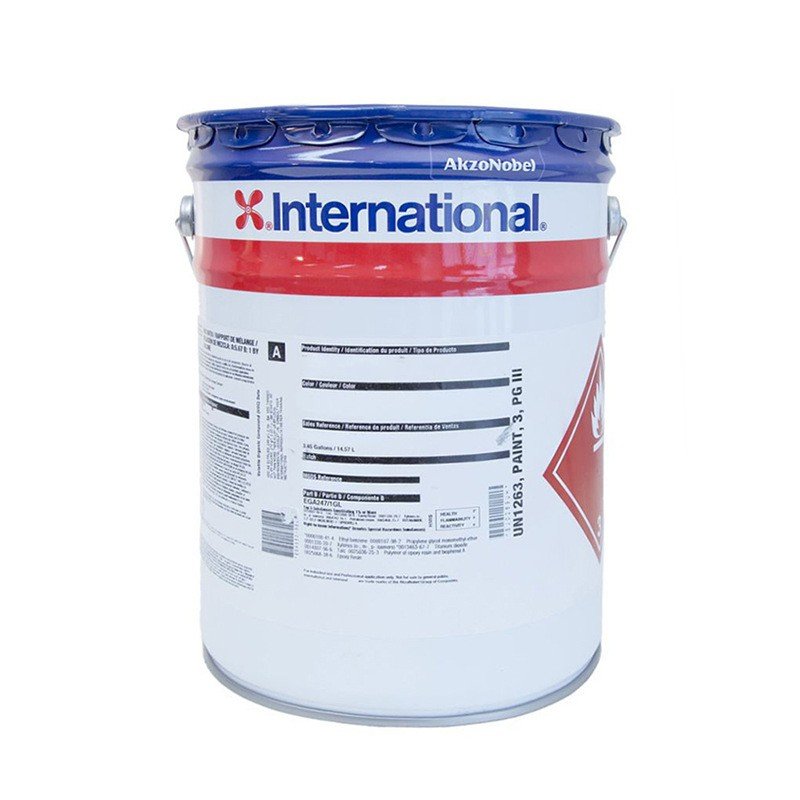
Interplate 317 Temporary Protective Primer is an inorganic zinc silicate paint used as a primer. The product is suitable for recoating with a variety of high-performance coating systems and is used in various environments (including offshore facilities, marine environments, chemical and petrochemical plants, power stations and bridges). A fast-drying two-component weldable zinc silicate shop primer, suitable for manual or automatic spraying. This product dries too quickly for accurate wet film thickness measurement; if a uniform film and surface roughness are not obtained, exposure to wind and sunlight will lead to rapid rusting. Parameters on this page: dry film thickness 10–25 µm (0.4–1 mil), theoretical spreading rate 18.67 m²/L, number of components: two-component.
Parameter source: AKZONOBEL manufacturer's Technical Data Sheet (TDS) "Interplate 317 Temporary Protective Primer"; values such as spreading rate are converted from TDS parameters and are for product selection reference only.
The above content is compiled from the manufacturer's datasheet and this site's parameter tables. For selection, coating systems and lead times, pleaseContact Usfor confirmation.
This page carries the full TDS for this product, translated from the manufacturer's original document. No file download is needed; for an original-language copy, send an enquiry.
| Volume Solids | 28% |
|---|---|
| Dry Film Thickness | 10–25 µm (0.4–1 mil) |
| Theoretical Spreading Rate | 18.67 m²/L |
| VOC | 609 g/L calculated value coating hazards GB 30981.2-S-Pb≤1… |
| Density / Specific Gravity | 1.5 kg/L (12.5 lb/gal) |
| Number of Components | Two-component |
| Thinner | Do not exceed the thinning limits of local environmental regulations |
| Mixing Ratio | 1 part : 1 part (by volume) |
| Colour / Appearance | Grey, INTERPLATE 317 |
For more Q&A on selection, application, acceptance and defect diagnosis, seeFAQsection.
A fast-drying, two-component, weldable zinc silicate shop primer, suitable for manual or automatic spraying.
As a temporary protective primer, suitable for application before the prefabrication of steel structures.
The product is suitable for overcoating with various high-performance coating systems, for use in various environments (including offshore installations, marine environments, chemical and petrochemical plants, power stations and bridges).
| Colour | Grey, INTERPLATE 317 |
|---|---|
| Gloss | Matt |
| Volume Solids | 28% |
| Typical thickness | DFT 10–25 µm (0.4–1 mil) corresponds to WFT 36–89 µm (1.4–3.6 mil) |
| Theoretical Spreading Rate | 18.67 m²/L at 15 µm dry film thickness and the stated volume solids; 749 ft²/US gal at 0.6 mil dry film thickness and the stated volume solids |
| Practical Spreading Rate | Allowing for a suitable loss factor |
| Application Methods | Suitable for airless spray, roller, air spray, brush and conventional spray. Drying time: recommended topcoat overcoating interval |
| Temperature | Surface Dry | Hard Dry | Minimum | Maximum |
| 10°C (50°F) | 3 min | 8 min | 24 h | Unlimited¹ |
| 15°C (59°F) | 3 min | 8 min | 24 h | Unlimited¹ |
| 25°C (77°F) | 3 min | 5 min | 24 h | Unlimited¹ |
| 40°C (104°F) | 3 min | 4 min | 24 h | Unlimited¹ |
¹ See Definitions and Abbreviations from the International Paint Protective Coatings division.
| Flash point (typical) | Component A 13°C (55°F); Component B 6°C (43°F); after mixing 6°C (43°F) |
|---|---|
| Product weight | 1.5 kg/L (12.5 lb/gal) |
| Volatile Organic Compounds | 609 g/L calculated value; coating hazard GB 30981.2-S-Pb≤1000-NC; complies with GB 30981.2-2025. For more detailed information, see the section on "Product Characteristics". |
All surfaces to be coated must be clean, dry and free of contaminants. Before application, all surfaces must be assessed and prepared in accordance with ISO 8504:2019.
Oil and grease shall be removed in accordance with SSPC-SP1 solvent cleaning. Where necessary, remove weld spatter and grind welds and sharp edges smooth.
Abrasive blast cleaning to at least Sa2½ (ISO 8501-1:2007) or SSPC-SP6. If oxidation occurs between abrasive blast cleaning and application of Interplate 317, the surface shall be re-blast cleaned to the specified visual standard. Surface defects exposed by abrasive blast cleaning shall be ground, filled or treated by other suitable methods.
The blasted surface shall have an angular profile. The blasting medium shall be steel grit with a nominal particle size of 0.6–1.0 mm (24–40 mil), or a steel grit/shot mixture with a nominal particle size of 0.6–1.0 mm (24–56 mil).
This product is not recommended for hand-prepared steel.
| Mixing | Interplate 317 is supplied in two parts: a paste component (Component A) and a liquid base component (Component B). Add the liquid base (Component B) slowly to the paste component (Component A) while stirring with a mechanical stirrer. |
|---|
Do not add the paste component to the liquid component. Filter the coating before application and maintain continuous stirring during spraying. Once a unit of coating is mixed, use it within the specified pot life.
This is a low-viscosity material, and stirring is required during application to maintain uniformity.
| Mixing ratio | 1 part : 1 part (by volume) |
|---|
| Pot life | 10°C (50°F) | 15°C (59°F) | 25°C (77°F) | 40°C (104°F) |
| 7 h | 6 h | 4.5 h |
| Suitable for airless spray | Recommended: for automatic equipment, tip size 0.53–0.64 mm (21–25 thou); for manual application, tip size 0.43–0.53 mm (17–21 thou); total paint pressure at the nozzle not less than 70 kg/cm² (995 psi) |
|---|
| Air Spray | Recommended | Spray gun | DeVilbiss MBC or JGA |
| Air nozzle | 704 or 765 | ||
| (with pressure pot) | Nozzle | E | |
| Air spray (conventional) | Recommended | Use suitable dedicated equipment. | |
| Brush | Suitable | For small areas or touch-up repair only. | |
| Roller application | Suitable | For small areas or touch-up repair only. | |
| Thinner | International GTA136 | Do not exceed the thinning limits of local environmental regulations |
| Cleaner | International GTA803 |
|---|---|
| Interruption of work | Do not leave paint in hoses, spray guns or spray equipment. Flush all equipment thoroughly with International thinner. Once mixed, paint should not be resealed; if work is interrupted for too long, mix a fresh batch. |
| Cleaning | All equipment should be cleaned immediately after use with International GTA 803. Flushing spray equipment periodically during daily work is good practice. Cleaning frequency depends on the volume sprayed, temperature, spraying time, including interruptions, and other factors. |
All surplus paint and empty containers must be disposed of in accordance with the appropriate local laws/regulations.
Satisfactory welding performance can only be achieved by strictly controlling the coating at the recommended film thickness. Overcoating Interplate 317 increases fume during welding or cutting and increases weld porosity. Interplate 317 is a coating designed for automatic equipment; for small-area hand spraying, avoid dry spray and application of subsequent coats.
Note that this product dries too quickly for an accurate wet film thickness to be measured. If a uniform film and surface profile are not achieved, rapid rusting will occur on exposure to weather.
The drying times given apply to the recommended dry film thickness using an automated process at the stated temperature. Failure to follow these parameters may cause damage to equipment and rollers and cracking of the painted surface due to handling damage during stacking. Optimum results are obtained by preheating the steel substrate to 40 °C (104 °F).
The thicker the film of Interplate 317, the longer the corrosion protection provided, but welding, cutting and handling performance will be affected. In most environments, 25 µm (1 mil) is the recommended dry film thickness to achieve 6–9 months of protection.
When relative humidity is below 50%, satisfactory curing for recoating cannot be achieved within 24 h. Below 50% relative humidity, the curing process is severely hindered; water vapour or water spray may be required to increase relative humidity. This product dries too fast for accurate wet film thickness measurement. Early exposure of Interplate 317 to standing water can cause discolouration, possibly permanent. This affects only the surface appearance and does not affect the anticorrosive performance of Interplate 317.
For more spraying information and weathering performance, contact the International Paint Protective Coatings Division.
The product has the following approvals: • Welding quality – approval of pre-primer (LR) • Welding quality – shop primer for corrosion protection of steel plates and components (DNV) • Welding quality – weldable prefabrication shop primer (ABS) Note: VOC values are typical and for guidance only. The values may vary with colour differences and normal manufacturing tolerances.
Interplate 317 can be recoated in various systems and is suitable for steel protection in multiple environments.
Suitable intermediate coats include:
| Intercure 200 | Intercure 420 |
|---|---|
| Intergard 251 | Intergard 269 |
| Intergard 343 | Intergard 475HS |
| Interseal 670HS | Intershield 300 |
| Interzone 1000 | Interzone 505Interzone 954 |
| For further information on the industry standards, terms and abbreviations used in this datasheet, see www.international-pc.com | In the following documents on the website: • Definitions and abbreviations • Surface preparation • Coating application • Theoretical and practical spreading rate. These sections are also available as separate publications on request. |
|---|
This product must be applied at the production site by professional applicators in accordance with the recommendations in this manual, the Material Safety Data Sheet and the instructions on the container label. Do not use this product without first reviewing the Material Safety Data Sheet (MSDS) that International Paint provides for its customers.
All work related to the application and use of this product must be carried out in accordance with the relevant national health, safety and environmental standards and regulations.
If welding or flame cutting is required on metal coated with this product, dust and fumes will be generated; use appropriate personal protective equipment and adequate local ventilation.
If in doubt about the suitability of this product for the intended use, consult AkzoNobel for further advice.
| Packaging Specifications | Component A | Component B | ||
| Volume | Packaging | Volume | Packaging | |
| 20 L | 10 L | 20 L | 10 L | |
For other packaging sizes, contact AkzoNobel.
| Packaging Specifications | Component A | Component B |
| 20 L | 21.89 kg | 9.31 kg |
| Shelf life | At 25°C (77°F), Component A 12 months, Component B 6 months. Inspection is required thereafter. Store in a dry, cool environment, away from heat and ignition sources. |
|---|
© 2026/5/27 AkzoNobel. All rights reserved.
All registered trademarks mentioned in this publication are licensed to or owned by AkzoNobel.
www.international-pc.com
Information is subject to the manufacturer's latest version; the manufacturer's latest TDS prevails.
The technical parameters on this page are taken from the product's original manufacturer technical datasheet, the copyright of which belongs to the manufacturer. If a rights holder considers the presentation inappropriate, contact us for verification and handling.
Packaging specifications and batch lead times are subject to actual availability. PleaseContact Uscontact us for project-based calculation.