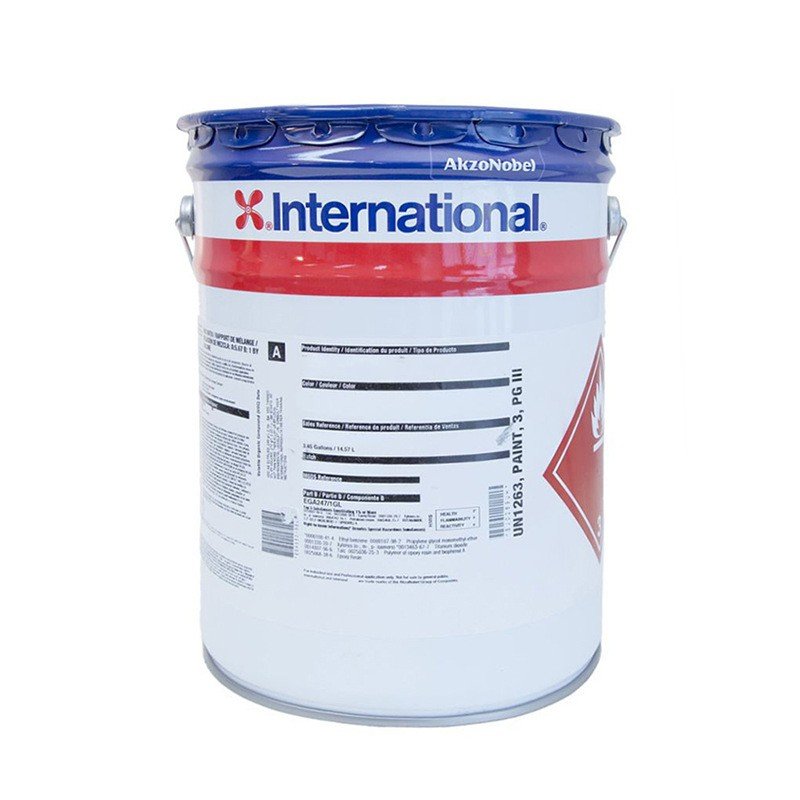
Interdur 8860HS is a polyurethane coating used as a topcoat. Suitable as a topcoat for new construction and maintenance, for use in a wide range of environments, including commercial buildings, chemical and petrochemical plants, bridges and the power industry. A two-component high-solids acrylic polyurethane topcoat with excellent weathering resistance and long-term recoatability. When recoating after weathering or ageing, ensure that the coating is thoroughly cleaned to remove all surface contaminants, such as oil, grease, crystalline salts and road dust, before applying the subsequent Interdur 8860HS coat. Parameters on this page: volume solids 65 ± 3%, dry film thickness 50-100 µm (2-4 mil), theoretical spreading rate 10.83 m²/L.
Parameter source: AKZONOBEL original technical data sheet (TDS) for Interdur 8860HS; spreading rate and other values are converted from TDS parameters and provided for product selection reference only.
The above content is compiled from the manufacturer's datasheet and this site's parameter tables. For selection, coating systems and lead times, pleaseContact Usfor confirmation.
This page carries the full TDS for this product, translated from the manufacturer's original document. No file download is needed; for an original-language copy, send an enquiry.
| Volume Solids | 65 ± 3% |
|---|---|
| Dry Film Thickness | 50–100 µm (2–4 mils) |
| Theoretical Spreading Rate | 10.83 m²/L |
| VOC | 2.79 lb/gal (335 g/L) US EPA Method 24 33… |
| Density / Specific Gravity | 1.39 kg/L (11.6 lb/gal) |
| Number of Components | Two-component |
| Thinner | Do not exceed the thinning limits of local environmental regulations |
| Mixing Ratio | 7 parts : 1 part (by volume) |
| Gloss |
For more Q&A on selection, application, acceptance and defect diagnosis, seeFAQsection.
A two-component high-solids acrylic polyurethane topcoat with excellent weathering resistance and long-term recoatability
Suitable as a topcoat for new construction and maintenance, for use in a wide range of environments, including commercial buildings, chemical and petrochemical plants, bridges and the power industry. Specifically designed as a gloss topcoat, Interdur 8860HS is suitable for use in all-season climates, for factory application and site application.
INTERDUR 8860HS wide range of colours available
| Gloss | |
|---|---|
| Volume Solids | 65 ± 3% |
| Typical thickness | DFT 50–100 µm (2–4 mil) corresponds to WFT 77–154 µm (3.1–6.2 mil) |
| Theoretical Spreading Rate | At 60 µm dry film thickness and the stated volume solids, 10.83 m²/L; at 2.4 mil dry film thickness and the stated volume solids, 434 ft²/US gal |
| Practical Spreading Rate | Allowing for a suitable loss factor |
| Application Methods | Suitable for airless spray, air spray, brush, roller. Drying time; recommended topcoat recoat interval |
| Temperature | Surface Dry | Hard Dry | Minimum | Maximum |
| 5°C (41°F) | 7.5 h | 24 h | Unlimited¹ | |
| 15°C (59°F) | 4 h | 12 h | Unlimited¹ | |
| 25°C (77°F) | 2 h | 9 h | Unlimited¹ | |
| 40°C (104°F) | 45 min | 2.5 h | Unlimited¹ | |
¹ See Definitions and Abbreviations from the International Paint Protective Coatings division.
| Flash point (typical) | Component A 32 °C (90 °F); Component B 49 °C (120 °F); mixed 29 °C (84 °F) |
|---|---|
| Product weight | 1.39 kg/L (11.6 lb/gal) |
| Volatile Organic Compounds | 2.79 lb/gal (335 g/L) US EPA Method 24; 333 g/L China national standard GB 23985. For further details, see the section on Product Characteristics. |
All surfaces to be painted must be clean, dry and free of contaminants. Before painting, all surfaces must be assessed and prepared in accordance with ISO 8504:2000.
Primed surfaces: Interdur 8860HS must always be applied over the recommended anticorrosive primer. The primer surface must be dry and free from any contamination, and Interdur 8860HS must be applied within the specified recoating interval (refer to the relevant product data sheet).
Areas of cracking, damage, etc. must be prepared to the specified standard (e.g. Sa 2½ (ISO 8501-1:2007) or SSPC SP6 abrasive blasting standard, or SSPC SP11 power tool cleaning standard), and the primer repaired before applying Interdur 8860HS.
| Mixing | This product is supplied in two containers forming one unit. Mix the two components in the specified ratio in one operation. Once mixed, use within the specified pot life. |
|---|
(1) Stir the base (Component A) with a power mixer.
(2) Mix all of the curing agent (Component B) with the base (Component A) and stir thoroughly with a power mixer.
| Mixing ratio | 7 parts : 1 part (by volume) |
|---|
| Pot life | 5°C (41°F) | 15°C (59°F) | 25°C (77°F) | 40°C (104°F) |
| 5 h | 2.5 h | 2 h | 45 min |
| Suitable for airless spray | Recommended: nozzle diameter 0.33–0.45 mm (13–18 thousandths of an inch); total paint pressure at the nozzle not less than 155 kg/cm² (2204 psi) |
|---|
| Air Spray | Recommended | Spray gun | DeVilbiss MBC or JGA |
| Air nozzle | 704 or 765 | ||
| (with pressure pot) | Nozzle | E | |
| Air spray (conventional) | Recommended | Use suitable dedicated equipment. | |
| Brush | Applicable | Typical thickness 40–50 µm (1.6–2.0 mils) | |
| Roller application | Applicable | Typical thickness 40–50 µm (1.6–2.0 mils) | |
| Thinner | International GTA713 | Do not exceed the thinning limits of local environmental regulations |
(or International GTA733 or GTA056)
| Cleaner | International GTA713 (or International GTA733 or GTA056) |
|---|---|
| Interruption of work | Do not leave paint in hoses, spray guns or spray equipment. Flush all equipment thoroughly with International GTA713. |
Once mixed, paint should not be resealed. If work is interrupted for too long, mix a fresh batch for application.
| Cleaning | All equipment shall be cleaned with International GTA 713 immediately after use. Periodically flushing spray equipment during the daily work is good practice. The frequency of cleaning depends on the quantity sprayed, temperature, spraying time and interruptions. |
|---|
All surplus paint and empty containers must be disposed of in accordance with the relevant local laws/regulations.
Gloss and surface smoothness depend on the application method. Mixing different application methods should be avoided where possible. Conventional air spray usually gives the optimum gloss and appearance.
For brush and roller application, two coats of Interdur 8860HS may be required for certain colours to achieve a uniform finish, particularly over dark primers or when using certain lead-free bright colours such as yellow and orange. Ideally, a colour-matched intermediate coat or anticorrosive coating should be used beneath Interdur 8860HS.
When recoating after weathering or ageing, ensure that the coating is thoroughly cleaned to remove all surface contaminants, such as oil, grease, crystalline salts and road dust, before applying the subsequent Interdur 8860HS coat.
The intercoat adhesion of a coat applied over aged Interdur 8860HS is lower than that over a fresh coat, but it is still adequate for the specified purpose.
This product may be thinned only with the recommended International thinner. Other thinners, especially alcohol-containing thinners, severely inhibit the curing mechanism of the coating.
The temperature of the surface to be coated must be at least 3 °C (5 °F) above the dew point.
When applying Interdur 8860HS in confined spaces, ensure adequate ventilation.
Interdur 8860HS can cure below 0 °C (32 °F). However, the product should not be applied at 0 °C (32 °F), as ice may be present on the substrate. Condensation on the surface during or after application will cause loss of gloss and a poor quality film. Premature exposure to standing water can cause colour change, particularly for dark colours and at low temperatures.
This product is not recommended for immersion service. If severe chemical or solvent splashes are likely, contact International Paint for information on suitability.
Note: VOC values are typical and for guidance only. They may vary with colour and general production tolerances.
Although the low-molecular-weight reactive additive becomes part of the film when cured under normal ambient conditions, analysis by EPA Method 24 shows that it also affects the VOC value.
The following primers/intermediate coats are recommended for Interdur 8860HS:
| Interdur 8800 | Interdur 8814 |
|---|---|
| Interdur 8801 | Interdur 8815 |
| Interdur 8802 | Interdur 8816 |
| Interdur 8808 | Interdur 8840 |
| Interdur 8809 | Interdur 8844, Interdur 8810. Interdur 8860HS is suitable for self-overcoating. |
For other suitable primers/intermediate coats, consult International Paint.
| For further information on the industry standards, terms and abbreviations used in this datasheet, see www.international-pc.com | In the following documents on the website: • Definitions and abbreviations • Surface preparation • Coating application • Theoretical and practical spreading rate. These sections are also available as separate publications on request. |
|---|
This product must be applied at the production site by professional applicators in accordance with the recommendations in this manual, the Material Safety Data Sheet and the instructions on the container label. Do not use this product without first reviewing the Material Safety Data Sheet (MSDS) that International Paint provides for its customers.
All work related to the application and use of this product must be carried out in accordance with the relevant national health, safety and environmental standards and regulations.
If welding or flame cutting is required on metal coated with this product, dust and fumes will be generated; use appropriate personal protective equipment and adequate local ventilation.
If in doubt about the suitability of this product, consult International Paint.
Warning: contains isocyanates. Wear an air-fed helmet when spraying.
| Packaging Specifications | Component A | Component B | ||
| Volume | Packaging | Volume | Packaging | |
| 20 L | 17.5 L | 20 L | 2.5 L | 5 L |
For other available packaging sizes, contact International Paint.
| Packaging Specifications | Component A | Component B |
| 20 L | 26.8 kg | 3.1 kg |
| Shelf life | At least 12 months at 25 °C (77 °F). Thereafter, inspect before use. |
|---|
Store in a dry, cool environment away from heat and sources of ignition.
© 2017/12/7 AKZONOBEL. All rights reserved.
www.international-pc.com
Information is subject to the manufacturer's latest version; the manufacturer's latest TDS prevails.
The technical parameters on this page are taken from the product's original manufacturer technical datasheet, the copyright of which belongs to the manufacturer. If a rights holder considers the presentation inappropriate, contact us for verification and handling.
Packaging specifications and batch lead times are subject to actual availability. PleaseContact Uscontact us for project-based calculation.