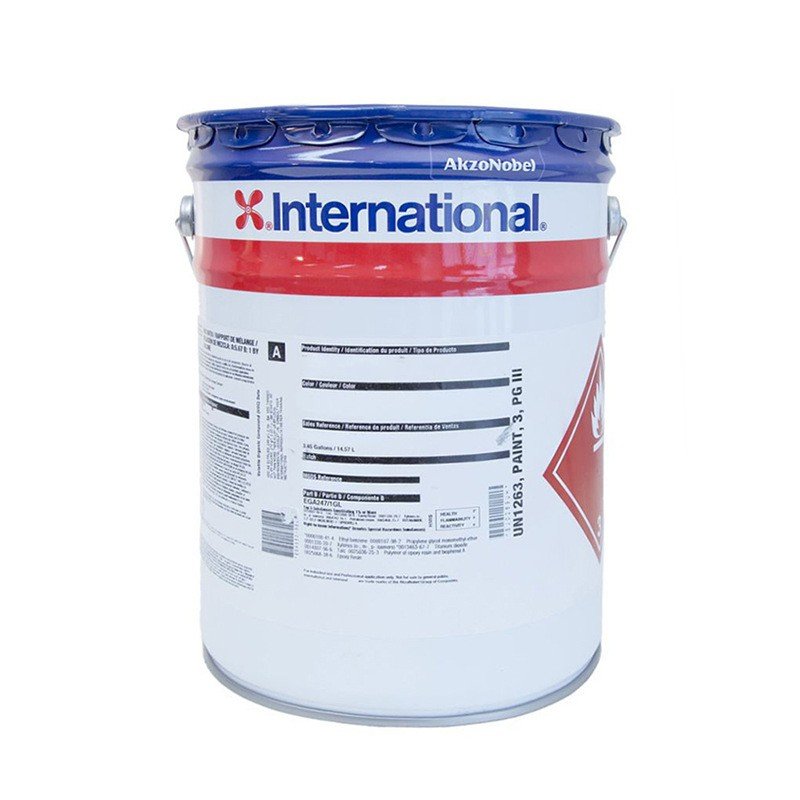
Chartek 7 is a widely certified epoxy intumescent fire protection coating, belonging to Fire Protection. It is mainly used in high-risk environments such as the oil, gas, LNG, petrochemical and power generation industries. The product is a high-build, two-component coating with excellent durability, combining corrosion resistance and fire protection performance, with 25 years of use cases in protecting against pool fire and high heat flux jet fire scenarios. After mesh application, continue spraying Chartek 7; only equipment approved by the AKZONOBEL Chartek 7 application specification manual and technical service representatives may be used to achieve the required film thickness. Parameters on this page: Volume Solids 100%, Number of Components two-component.
Parameter source: AKZONOBEL original technical data sheet (TDS) “Chartek 7 widely certified epoxy intumescent fire protection coating”; values such as spreading rate are converted from TDS parameters and are for selection reference only.
The above content is compiled from the manufacturer's datasheet and this site's parameter tables. For selection, coating systems and lead times, pleaseContact Usfor confirmation.
This page carries the full TDS for this product, translated from the manufacturer's original document. No file download is needed; for an original-language copy, send an enquiry.
| Volume Solids | 100% |
|---|---|
| Dry Film Thickness | — |
| Theoretical Spreading Rate | — |
| VOC | 0.00 lb/gal (0 g/L) US EPA Method 24, 1 g/… |
| Density / Specific Gravity | 1000 kg/m³ (62.427 lb/ft³) - two-pump spray application (ISO … |
| Number of Components | Two-component |
| Thinner | For premixed application and trowel application only — refer to the Chartek 7 application specification manual |
| Mixing Ratio | 2.45 parts : 1 part by weight (refer to Chartek 7 application specification … |
| Gloss | N/A |
For more Q&A on selection, application, acceptance and defect diagnosis, seeFAQsection.
Chartek 7 is a high-performance, widely certified epoxy intumescent fire protection coating.
The product is a high-build, two-component coating with excellent durability, combining corrosion resistance and fire protection performance, with 25 years of use cases in protecting against pool fire and high heat flux jet fire scenarios.
Structural fire protection certification obtained on carbon steel and galvanized steel substrates. The standards on which testing is based include ANSI UL 1709, BS476:476-20/21 (Part 20 Appendix D), ISO TR834-3(1994), ISO 834:1975, ISO 22899-1:2007, IMO Res.A 754(18), OTI 95 634, IMO Res.MSC(61/67), IMO Res.MSC 307(88), GOST-EN 1362-2:2014, IMO Res.A 753(18) ISO 22899-2, ISO/TR 834-1, ASTM E1529, IMO Res.A 517(13), NORSOK M501-Rev6.
Suitable for protecting steel, aluminium and other substrates against hydrocarbon pool fire and jet fire.
Protects the functional integrity of structures and process equipment within the specified time.
Mainly used in high-risk environments, such as the oil, gas, liquefied natural gas, petrochemical and power generation industries.
CHARTEK7
| Gloss | N/A |
|---|---|
| Volume Solids | 100% |
| Typical thickness | Depending on the protection required. |
| Theoretical Spreading Rate | 1 kg of Chartek 7 will provide 1 mm of fire protection coating over an area of 1 m² (based on multi-component spray application) |
| Practical Spreading Rate | Allowing for a suitable loss factor |
| Density | 1000 kg/m³ (62.427 lb/ft³) — twin-pump spray application (ISO 1183-1 (2019)) |
| Application Methods | Heated two-component airless spray. Drying time: recommended topcoat overcoating interval |
| Temperature | Surface Dry | Hard Dry | Minimum | Maximum |
| 10°C (50°F) | 3 h | 18 h | * | |
| 20°C (68°F) | 1.5 h | 8 h | * | |
| 40°C (104°F) | 1 h | 4 h | * | |
* Consult AKZONOBEL for further information
| Flash point (typical) | Component A >106 °C (223 °F); Component B >106 °C (223 °F); mixed >106 °C (223 °F) |
|---|---|
| Volatile Organic Compounds | 0.00 lb/gal (0 g/L) US EPA Method 24, 1 g/kg, EU Solvent Emissions Directive (Council Directive 2010/75/EU). Coating hazard class GB 30981.2-S-Pb≤1000-NC, complying with GB 30981.2-2025. For more details, see the 'Product Characteristics' section. |
Surface preparation and application should be carried out in accordance with the recommendations given in the AKZONOBEL Chartek 7 Application Specification Manual.
All surfaces to be coated must be clean, dry and free of contaminants. Before application, all surfaces must be assessed and prepared in accordance with ISO 8504:2019.
Abrasive blasting Chartek 7 is generally suitable for surfaces that have been abrasive blast cleaned to Sa2½ (ISO 8501-1:2007) or SSPC-SP10 and coated with a suitable primer.
The selected primer or primer system must be on the AkzoNobel qualified primer list. The preferred primer is an epoxy type specified at no more than 75 µm (3 mils). A two-coat primer system, such as epoxy zinc-rich and tie coat, may also be used; the combined specified thickness should not exceed 110 µm (4.5 mils).
| Mixing | For trowel application, the individual components should be stored at 35 °C (95 °F) and thoroughly power-stirred before mixing. |
|---|---|
| Mixing ratio | 2.45 parts : 1 part by weight (refer to the Chartek 7 Application Specification Manual) |
| Pot life | 10°C (50°F) | 20°C (68°F) | 40°C (104°F) |
| 110 min | 70 min | 15 min |
The pot life value refers to unthinned trowel application performance after pre-warming to 35 °C (95 °F) before stirring. If the material is not pre-warmed, the pot life is extended but mixing is more difficult. The pot life does not apply to two-pump airless spray application, because the product is mixed only in the static mixer near the gun. Refer to the product application manual.
| Plural-component airless spray | Recommended and preferred equipment | AkzoNobel-approved heated twin-pump equipment. No thinner required |
| Suitable for airless spray | Suitable | Use of AKZONOBEL-approved modified airless spray equipment is recommended, minimum |
68:1. Normally up to 5% by volume solvent dilution.
| Trowel application | Suitable | Refer to the Chartek 7 Application Specification Manual |
| Thinner | International GTA123 | For premixed application and trowel application only — refer to the Chartek 7 application specification manual |
| Cleaner | International GTA007 |
|---|---|
| Interruption of work | Do not leave paint in hoses, spray guns or spray equipment. Flush all equipment thoroughly with International thinner. Once mixed, paint should not be resealed; if work is interrupted for too long, mix a fresh batch for application. |
| Cleaning | All equipment should be cleaned immediately after use with International thinner. Flushing spray equipment periodically during daily work is good practice. Cleaning frequency depends on the volume sprayed, temperature, spraying time, including delays, and other factors. |
All surplus paint and empty containers must be disposed of in accordance with the relevant local laws/regulations.
Throughout application, the following conditions must be present (or created):
| Minimum air temperature | 10°C (50°F) |
|---|---|
| Maximum humidity | 85% |
| Surface temperature | At least 3 °C (5 °F) above the dew point of the surrounding air. |
| General | All surfaces to be coated must be clean, dry and free of contaminants. |
Immediately before application.
Chartek 7 should be applied by spray application to ensure complete wetting of the substrate. If application is by means other than spray, the first coat should be thoroughly trowel-applied and roller-applied to achieve this.
The preferred self-recoat time for Chartek 7 is after the minimum self-recoat interval has been reached, or before the coating has any chance of being contaminated.
When recoating Chartek 7 with a decorative topcoat, the following recoat intervals apply: minimum maximum*
| 10°C (50°F) | 24 h; 7 days |
|---|---|
| 25°C (77°F) | 18 h; 7 days |
| 40°C (104°F) | 6 h 4 days (*For Interthane 990 the maximum recoat interval is 6 months) Mesh installation (if applicable) Some require no reinforcing mesh. If reinforcing mesh is required, AkzoNobel HK-1 or HK-2 carbon fibre mesh should be installed in accordance with the specific fire protection design and installed in accordance with the detailed instructions in the Chartek 7 Application Specification Manual. For mesh requirements, seek specific advice from AKZONOBEL. |
Continue spray application of Chartek 7 after mesh installation to achieve the required film thickness. Equipment Only equipment approved by AKZONOBEL in the Chartek 7 Application Specification Manual and by the technical service representative may be used.
Applicator certification Only companies holding a qualified applicator certificate issued by AKZONOBEL may apply Chartek 7. These companies must provide documentary evidence prior to application.
Chartek 7 application should be carried out by the applicator company using personnel who have been trained in the correct application procedures and are qualified. At a minimum, site supervisors and QA/QC personnel should hold individual qualifications and have attended the AKZONOBEL Chartek applicator training course. This is the minimum requirement and must be documented in writing prior to application.
Inspection and quality assurance. This is the applicator's responsibility and must at least follow the procedures specified in the AkzoNobel Chartek QC manual. Technical service. Available from AkzoNobel and should be coordinated to be present at start of work. The applicator is responsible for ensuring AkzoNobel is notified of the start date.
Other surface preparation. For some project-specific environments, AkzoNobel has developed procedures for wet blasting, ultra-high-pressure water jetting and power tool preparation.
Maximum surface operating temperature When the temperature is between 80°–120 °C (176°–248 °F), a suitable thermal insulation layer, such as Intertherm 7050, should be used between the substrate and Chartek 7.
Note: Application density values are typical and for guidance purposes only. Refer to the Chartek 7 Application Specification Manual.
Chartek 7 is designed for application to substrates that have been correctly prepared and coated with a suitable primer. The following primers may be used with Chartek 7:
| Intergard 269 | Intershield 300 |
|---|---|
| Intergard 251 | Intershield 4000USP |
| Intergard 2511 | Interzinc 52/Intergard 269Intergard 2575Intergard 7500 Typically Chartek 7 will be topcoated to meet the owner's colour scheme and topcoat requirements. AKZONOBEL Protective Coatings recommends the use of a topcoat in all external service environments. |
The following topcoats are recommended for use with Chartek 7: Interthane 990Interfine 2080*Interzone 954*Available by region
| For further information on the industry standards, terms and abbreviations used in this datasheet, see www.international-pc.com | In the following documents on the website: • Definitions and abbreviations • Surface preparation • Coating application • Theoretical and practical spreading rate. These sections are also available as separate publications on request. |
|---|
This product must be applied at the production site by professional applicators in accordance with the recommendations in this manual, the Material Safety Data Sheet and the instructions on the container label. Do not use this product without first reviewing the Material Safety Data Sheet (MSDS) that International Paint provides for its customers.
All work related to the application and use of this product must be carried out in accordance with the relevant national health, safety and environmental standards and regulations.
If welding or flame cutting is required on metal coated with this product, dust and fumes will be generated; use appropriate personal protective equipment and adequate local ventilation.
If in doubt about the suitability of this product for the intended use, consult AkzoNobel for further advice.
| Unit | Component A | Component B |
| Weight | ||
| 20 kg (44.1 lb) per unit | 14.2 kg (31.3 lb) | 5.8 kg (12.8 lb) |
| 50 kg (110.2 lb) per unit | 35.48 kg (78.2 lb) | 14.52 kg (32.0 lb) |
Supplied as a 20 kg (44.1 lb) unit, comprising one drum of Component A and one plastic drum of Component B. The Component A drum normally has spare volume to hold Component B, allowing thorough power-tool mixing before application.
Supplied as a 50 kg (110.2 lb) unit, comprising two full drums of Component A and one full drum of Component B, suitable for airless spray application.
For other packaging sizes, contact AkzoNobel.
| Unit | Component A | Component B |
| Weight | ||
| 20 kg (44.1 lb) per unit | 16.0 kg (35.2 lb) | 6.4 kg (14.1 lb) |
| 50 kg (110.2 lb) per unit | 39.1 kg (86.0 lb) | 16.3 kg (36.0 lb) |
| Shelf life | At least 18 months at storage temperatures of 1 °C (34 °F) to 30 °C (86 °F). Store indoors, away from direct sunlight. |
|---|
The information given in this product data sheet is not exhaustive. Anyone who uses, for any purpose, any product other than those specifically recommended in this data sheet without first obtaining our written confirmation does so at their own risk as regards the suitability of the product for the intended purpose. Although to the best of our knowledge all advice or statements given about the product (whether in this data sheet or otherwise) are correct, we cannot control the quality or condition of the substrate, nor the many factors affecting the use and application of the product. Accordingly, unless we specifically agree otherwise in writing, we accept no liability, to the maximum extent permitted by law, for any product performance problem arising, or for any loss or damage caused by use of the product. We hereby disclaim any warranty or representation, express or implied, arising by operation of law or otherwise, including but not limited to any implied warranty of merchantability or fitness for a particular purpose. All products supplied and all technical guidance provided are subject to our standard terms and conditions of sale. You should obtain a copy of this document and read it carefully. The information contained in this product data sheet may be amended at any time in the light of experience and of our product development policy. Before using the product, it is the customer's responsibility to check with the local representative that the data sheet in their possession is the latest version.
This product data sheet is available on www.international-marine.com or www.international-pc.com and should be identical to this copy. If the version on the website differs from this one, the version on the website shall prevail.
© 2026/5/26 AkzoNobel. All rights reserved.
www.international-pc.com
Data is subject to the manufacturer's latest version; in all cases the manufacturer's latest TDS prevails.
Packaging specifications and batch lead times are subject to actual availability. PleaseContact Uscontact us for project-based calculation.