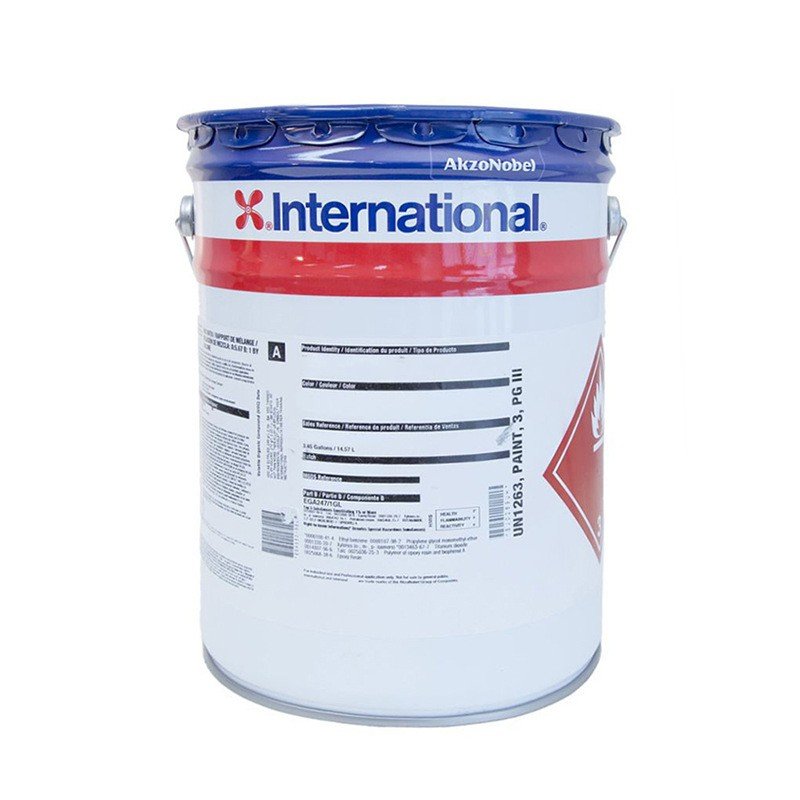
Ceilcote 74 Lining Heavy-duty Anticorrosive Lining Coating is a vinyl ester coating. When special chemical-resistant anticorrosive protection is required, Ceilcote 74 Lining provides durable, reliable protection for tanks and trenches. Ceilcote 74 Lining is a heavy-duty anticorrosive lining coating applicable by trowel, providing anticorrosive protection for steel and concrete structures in immersion environments with strongly corrosive media. (The second coat requires a film hardener.) If the recoat interval is exceeded, wipe with styrene to confirm recoating is possible. Parameters on this page: volume solids 100% reactive; dry film thickness 1500 µm (60 mils); theoretical spreading rate 0.57 m²/L.
Source: AKZONOBEL original technical data sheet (TDS) 'Ceilcote 74 Lining Heavy-duty Anticorrosive Lining Coating'. Spreading rate and other values converted from the TDS; for reference only.
The above content is compiled from the manufacturer's datasheet and this site's parameter tables. For selection, coating systems and lead times, pleaseContact Usfor confirmation.
This page carries the full TDS for this product, translated from the manufacturer's original document. No file download is needed; for an original-language copy, send an enquiry.
| Volume Solids | 100% active |
|---|---|
| Dry Film Thickness | 1500 µm (60 mils) |
| Theoretical Spreading Rate | 0.57 m²/L |
| VOC | 1.36 lb/gal (163 g/L) US EPA Method 24, 43… |
| Density / Specific Gravity | 1.11 kg/L (9.3 lb/gal) |
| Number of Components | Two-component |
| Thinner | Do not thin |
| Mixing Ratio | 1 L Component A : 15 mL Component B (1 gal Component A : 2 fl oz Component B) |
| Gloss | N/A |
For more Q&A on selection, application, acceptance and defect diagnosis, seeFAQsection.
Ceilcote 74 Lining is a heavy-duty anticorrosive lining coating applicable by trowel, providing anticorrosive protection for steel and concrete structures in immersion environments with strongly corrosive media. The lining is composed mainly of vinyl ester resin, inert fillers and reinforcing glass fibre. It can resist some dilute inorganic acids and some concentrated acids, such as phosphoric acid.
When special chemical-resistant anticorrosive protection is required, Ceilcote 74 Lining provides durable, reliable protection for tanks and trenches.
Its high chemical resistance also makes it suitable for secondary containment.
CEILCOTE 74 LINING, colour: grey
| Gloss | N/A |
|---|---|
| Volume Solids | 100% active |
| Typical thickness | Base coat: (resin + powder) single coat 1500 µm (60 mils) dry film thickness, equivalent to 1765 µm wet film, theoretical coverage 1.27 m²/L (55 ft²/US gal). Laminate (resin-wetted reinforcement mesh layer): two coats, each 800 µm (32 mils), theoretical spreading rate 1.34 m²/L (50 ft²/US gal); press the surface mat into the surplus resin layer. |
Topcoat: (resin only) two coats at a dry film thickness of 150 µm (6 mil) corresponding to a wet film thickness of 176 µm (7 mil), theoretical spreading rate 5 m²/L (200 ft²/US gal)
| Practical Spreading Rate | At 1500 µm dry film thickness and 85% volume solids, the theoretical spreading rate is 0.57 m²/L; at 60 mils dry film thickness and 85% volume solids, 23 ft²/US gal (for more details, refer to the 'Product Characteristics' section) |
|---|---|
| Application Methods | Trowel; for drying time refer to the recommended topcoat recoat interval |
| Temperature | Surface Dry | Hard Dry | Minimum | Maximum |
| 10°C (50°F) | 3 h | 15 h | 12 h | 7 days¹ |
| 15°C (59°F) | 2.5 h | 11.5 h | 8 h | 7 days¹ |
| 25°C (77°F) | 60 min | 3 h | 4 h | 7 days¹ |
| 35°C (95°F) | 45 min | 2 h | 3 h | 3 days¹ |
¹ When the surface temperature exceeds 35 °C (95 °F) or the surface is exposed to sunlight, recoat as soon as the coating is hard enough to walk on, to avoid intercoat adhesion problems.
| Flash point (typical) | Component A 32 °C (90 °F); Component B 77 °C (171 °F); mixed 32 °C (90 °F) |
|---|---|
| Product weight | 1.11 kg/L (9.3 lb/gal) |
| Volatile Organic Compounds | 1.36 lb/gal (163 g/L) US EPA Method 24, 43 g/kg, EU Solvent Emissions Directive 1999/13/EC. For more details, see the 'Product Characteristics' section. |
All surfaces to be coated must be clean and free of contamination. Before application, all surfaces must be assessed and prepared in accordance with ISO 8504:2000.
Oil and grease must be removed in accordance with the SSPC-SP1 solvent cleaning standard.
For steel substrates in immersed, damp or high-temperature service, the product shall be applied over a surface blast-cleaned to Sa3 (ISO 8501-1:2007), SSPC SP5 or NACE No. 1 and coated with a suitable primer. For dry or fume environments, blast cleaning to Sa2½ (ISO 8501-1:2007), SSPC SP10 or NACE No. 2 is appropriate. The surface profile shall be at least 75 µm (3 mil).
Concrete substrate: the concrete must be fully cured before applying the primer. The concrete surface must be dry and pass the ASTM D4263 plastic sheet test. All surfaces should be clean and dry, free of curing compounds, smoothing materials, hardeners, efflorescence, grease, dirt, old coatings and loose or disintegrated concrete. All concrete surfaces must be blast-prepared to provide a rough surface, removing laitance. The surface tensile strength (ASTM 4541) should be at least 2 MPa (300 PSI). For more information, refer to the concrete surface preparation guide.
| Mixing | Ceilcote 74 Lining must be mixed and applied per the detailed application instructions of the subsequent system. |
|---|
The resin component is supplied as two cans per unit. Normally the whole unit is mixed. Once mixed, it shall be used within the specified pot life. (1) Shake Component A, then pour the whole cans of Component A and Component B together and mix thoroughly with a power stirrer. (2) Component C, the powder component, shall be added slowly while Components A and B are being stirred. For specific quantity requirements, refer to the product data section.
| Mixing ratio | 1 L Component A : 15 mL Component B (1 gal Component A : 2 fl oz Component B) |
|---|
| Pot life | 10°C (50°F) | 15°C (59°F) | 25°C (77°F) | 35°C (95°F) |
| 90 min | 60 min | 30 min |
| Suitable for airless spray | N/A |
|---|
| Brush | Recommended | Suitable for wetting with resin and smoothing liquid surfaces |
| Roller application | Recommended | Suitable for wetting with resin and smoothing liquid surfaces |
| Trowel application | Recommended | For applying the base coat |
| Thinner | Do not thin |
| Cleaner | Ceilcote T-410 Solvent or MEK |
|---|---|
| Interruption of work | Use immediately after mixing; if the pot life is exceeded, discard and mix a fresh batch. |
| Cleaning | Clean immediately after use with T-410 Solvent. |
All surplus material and empty containers must be disposed of in accordance with local regulations.
Before using the relevant Ceilcote system, read the detailed Application Guide.
Application of Ceilcote 74 Lining requires the contractor's staff to have completed full application training. It is strongly recommended that applicators and supervisors be professionals with proper product training.
Although Ceilcote 74 Lining is 100% reactive, the actual volume solids may be lower depending on application conditions; International Industrial Coatings recommends an estimated spreading rate value of 85%.
Before work begins, International Paint provides a precise system for dry film thickness and number of coats.
The steel substrate surface temperature must be at least 3 °C (5 °F) above the dew point. During application and curing, ensure adequate ventilation. It may be necessary to use dehumidification, air conditioning and/or heating equipment to control the ambient conditions.
At all stages of application, the surface, air and paint temperatures must be between 10 °C (50 °F) and 43 °C (110 °F).
The required powder grade and the amount of powder to be stirred into the resin per litre (and gallon) are as follows: S-1 powder 2.6–3.1 kg/L (22–26 lb/gal). The powder is added to the base coat only.
Application: 1. Using a trowel, apply a base coat of 1000–2000 µm (40–80 mil) (target 1500 µm, 60 mil).
2. Press the reinforcement mesh into the base coat without wrinkling or entrapping air, and wet out the mesh with resin until it becomes transparent.
3. Apply the second reinforcement mesh in the same way as step 2.
4. After steps 2 and 3, press the surface mat into the remaining resin and allow it to cure.
5. Apply two topcoats, each 150 µm (6 mil). (The second coat requires a film curing agent.) If the overcoating interval is exceeded, wipe with styrene to check whether overcoating is possible. If the surface feels 'slightly tacky', adhesion is acceptable. If it is not softened by styrene, sweep-blast or mechanically abrade the surface to obtain a matte, rough surface. Primed surfaces shall be dry and free from foreign matter before lining, coating or flooring application.
Following the correct application procedure, Ceilcote 74 Lining can be returned to service after the following intervals: 10 °C (50 °F): 48 h; 20 °C (70 °F): 24 h; 35 °C (90 °F): 16 h. Ceilcote 74 Lining is not intended as a decorative topcoat and colour stability is difficult to achieve.
Note: VOC values are typical and for guidance only. They may vary with colour and general production tolerances.
Although the low-molecular-weight reactive additive becomes part of the film when cured under normal ambient conditions, analysis by EPA Method 24 shows that it also affects the VOC value.
Ceilcote 74 Lining should always be applied over a correctly prepared primer surface. Suitable primers are: Ceilcote 380, Ceilcote 370HT
| For further information on the industry standards, terms and abbreviations used in this datasheet, see www.international-pc.com | In the following documents on the website: • Definitions and abbreviations • Surface preparation • Coating application • Theoretical and practical spreading rate. These sections are also available as separate publications on request. |
|---|
This product is intended for professional applicators in industrial use only.
All work, including the application and use of this product, must comply with the relevant national standards, laws and regulations on safety, health and environmental protection.
During application and the subsequent drying period, provide adequate ventilation to keep solvent concentrations within safe limits and prevent fire and explosion (for general drying times, see the product data sheet). Forced ventilation is required in confined spaces. During application and drying, personal ventilation and/or respiratory protection (e.g. air-fed hood or suitable filter mask) must also be provided. Take the necessary measures to prevent skin and eye contact with the coating (e.g. protective clothing, gloves, goggles, mask, barrier cream).
Before use, read and follow the Health and Safety section of the Material Safety Data Sheet and the application procedure for the product (for two-component coatings, those of the base and curing agent).
If welding or flame cutting is performed on metal substrate coated with this product, dust and fumes will be released; use suitable personal protective equipment and local exhaust ventilation.
The specific safety measures depend on the application method and working environment. If these warnings or instructions are not fully understood or cannot be strictly observed, do not use the product and consult the International Paint Protective Coatings division.
| Packaging Specifications | Component A | Component B | ||
| Volume | Packaging | Volume | Packaging | |
| 15 L | 14.71 L | 20 L | 0.29 L | 0.7 L |
| 4 US gal | 5 US gal | 10 fl oz | 1 US pint | |
For other available packaging sizes, contact International Paint.
| Packaging Specifications | Component A | Component B |
| 15 L | 17.65 kg | 0.39 kg |
| 5 US gal | 41.9 lb | 1 lb |
Powder packaging is generally 20 kg or 50 lb depending on place of production. For further information, consult International Paint.
| Shelf life | Storage life 6 months at 20 °C (68 °F); inspect before use thereafter. Store in a dry, cool environment away from heat and ignition sources. During storage and transport, the temperature of the Ceilcote 74 Lining initiator must not exceed 30 °C (90 °F). Refrigeration is recommended. Store Part A and Part B separately. |
|---|
© 2018/4/12 AkzoNobel. All rights reserved.
All registered trademarks mentioned in this publication are licensed to or owned by AkzoNobel.
www.international-pc.com
Information is subject to the manufacturer's latest version; the manufacturer's latest TDS prevails.
The technical parameters on this page are taken from the product's original manufacturer technical datasheet, the copyright of which belongs to the manufacturer. If a rights holder considers the presentation inappropriate, contact us for verification and handling.
Packaging specifications and batch lead times are subject to actual availability. PleaseContact Uscontact us for project-based calculation.